



Store and easily access your documents
Trusted by over 10000 happy users
























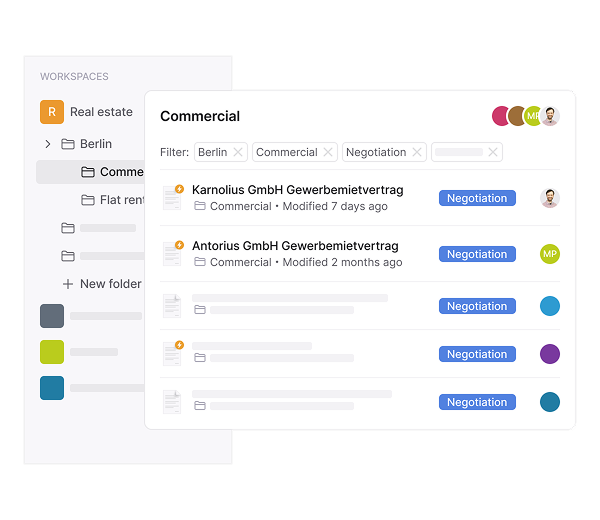
Tailor workspaces to fit your organization
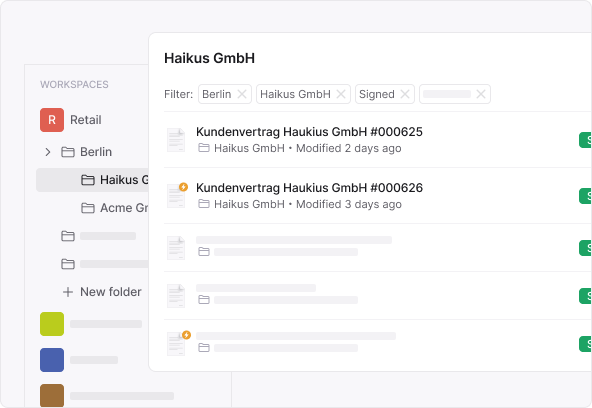
Whether by department, client group, or project type — create clearly defined digital environments with folders, subfolders, and smart permission settings.
Define permission settings and control access with precision
Whether you’re managing internal teams or collaborating with external partners, you can limit visibility to high-priority areas or open specific folders to selected users. Assign roles like admin, editor, or viewer, and customize access down to the folder or even document level. Onboard new teammates, scale securely, and stay fully compliant — all with just a few clicks.
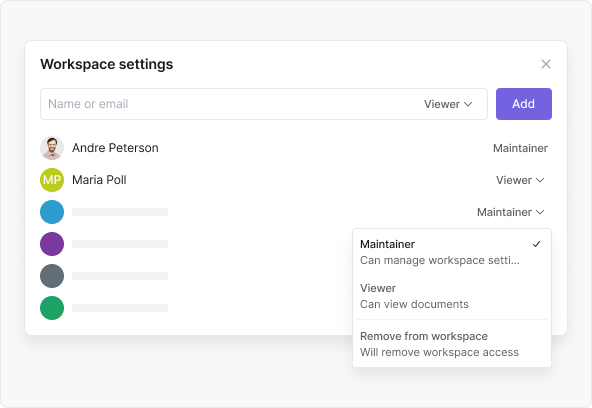
Secure private workspaces for sensitive contracts
With unlimited folder depth, you can replicate the exact structure of your team’s internal file system, including departments, client directories, or project phases.
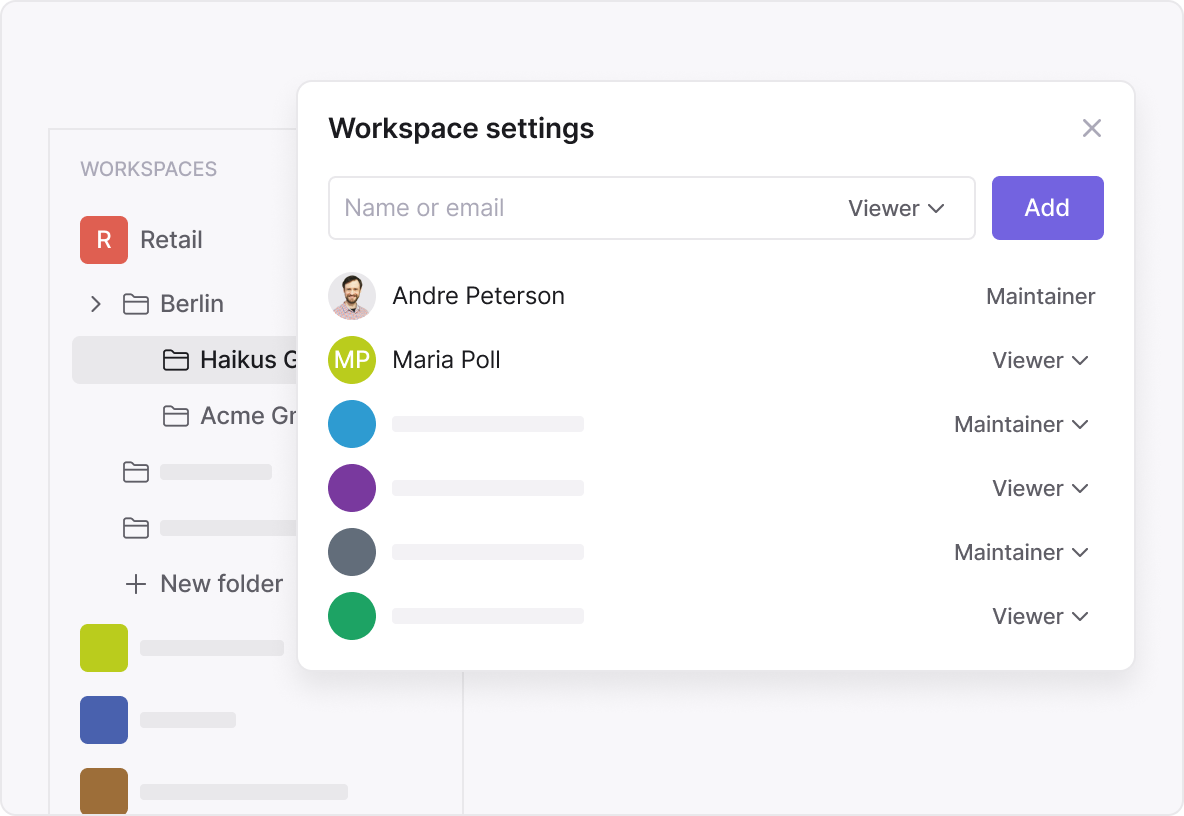
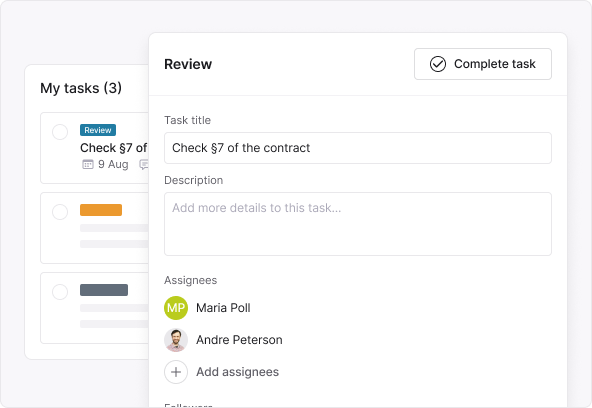
Assign and reassign tasks and documents
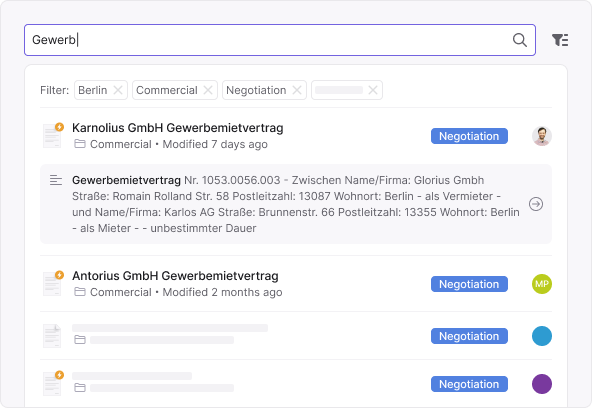
Find any document instantly with smart global search
Use powerful full-text search and advanced filters to locate contracts by title, content, contract type, involved parties, due dates, or tags. No more endless clicking through folder trees. Whether you’re prepping for a meeting or answering a legal inquiry, you’ll always have the right contract at your fingertips.
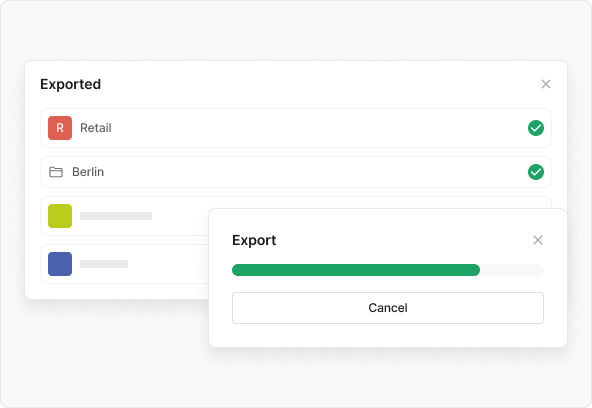
Create custom reports across workspaces or company-wide
Build and export reports in seconds on:
- Contract timelines, renewal deadlines, and expiration risks
- Assigned owners, open tasks, and status tracking
- Clauses flagged for risk or compliance
- Missing signatures and approval bottlenecks
Export reports in Excel, share them with leadership or auditors, and stay always audit-ready. Whether you’re managing compliance, performance, or strategic planning — Inhubber’s reporting engine gives you the clarity to act.
“Powerfully simple”
 Automatic deadline monitoring is a real game changer for us. We used to manage deadlines manually in Excel spreadsheets, which was naturally error-prone. Now Inhubber ensures that we are notified in a timely manner about upcoming termination periods. This has already saved us from unnecessary costs.
Automatic deadline monitoring is a real game changer for us. We used to manage deadlines manually in Excel, which was error-prone. Now Inhubber notifies us in time about upcoming termination periods, helping us avoid missed deadlines and unnecessary costs.
Automatic deadline monitoring is a real game changer for us. We used to manage deadlines manually in Excel spreadsheets, which was naturally error-prone. Now Inhubber ensures that we are notified in a timely manner about upcoming termination periods. This has already saved us from unnecessary costs.
Automatic deadline monitoring is a real game changer for us. We used to manage deadlines manually in Excel, which was error-prone. Now Inhubber notifies us in time about upcoming termination periods, helping us avoid missed deadlines and unnecessary costs.

 Especially in the logistics sector, many contracts are long and complex. With the AI summary, I can understand a 40-page contract in just a few sentences. This saves an incredible amount of time. When I log in in the morning, I immediately see upcoming deadlines, tasks, and signature requests. That way, I know right away what I need to focus on. It used to be much more unclear.
Especially in logistics, contracts are often long and complex. With AI summaries, I can understand a 40-page contract in seconds, saving significant time. Each morning, I instantly see deadlines, tasks, and signature requests—so I know exactly what to focus on.
Especially in the logistics sector, many contracts are long and complex. With the AI summary, I can understand a 40-page contract in just a few sentences. This saves an incredible amount of time. When I log in in the morning, I immediately see upcoming deadlines, tasks, and signature requests. That way, I know right away what I need to focus on. It used to be much more unclear.
Especially in logistics, contracts are often long and complex. With AI summaries, I can understand a 40-page contract in seconds, saving significant time. Each morning, I instantly see deadlines, tasks, and signature requests—so I know exactly what to focus on.

 Inhubber has fundamentally changed the way we handle our contracts by providing a user-friendly and efficient platform that ensures complete transparency. This change has led to significant time savings, particularly through improved organization and accessibility of data. In the financial sector, it is especially useful as it helps keep track of costs and deadlines, making it an essential tool for our sustainable growth.
Inhubber has transformed contract management with a user-friendly platform and full transparency. It saves time through better organization and data access. In finance, it’s valuable for tracking costs and deadlines, supporting growth.
Inhubber has fundamentally changed the way we handle our contracts by providing a user-friendly and efficient platform that ensures complete transparency. This change has led to significant time savings, particularly through improved organization and accessibility of data. In the financial sector, it is especially useful as it helps keep track of costs and deadlines, making it an essential tool for our sustainable growth.
Inhubber has transformed contract management with a user-friendly platform and full transparency. It saves time through better organization and data access. In finance, it’s valuable for tracking costs and deadlines, supporting growth.

 Thanks to Inhubber, it is now much easier and faster to rent out apartments, and I can even rent them out across the country without having to be there.
Thanks to Inhubber, it is now much easier and faster to rent out apartments, and I can even rent them out across the country without having to be there.
Thanks to Inhubber, it is now much easier and faster to rent out apartments, and I can even rent them out across the country without having to be there.

 Before we introduced Inhubber, we missed termination deadlines several times simply because no one remembered that the contract still existed and needed to be cancelled. This led to unnecessary costs that we wanted to avoid. With Inhubber, we can now be confident that this will no longer happen.
Before Inhubber, we missed termination deadlines because contracts were overlooked, leading to unnecessary costs. Now, we’re reliably notified in time and can be confident that deadlines are no longer missed.
Before we introduced Inhubber, we missed termination deadlines several times simply because no one remembered that the contract still existed and needed to be cancelled. This led to unnecessary costs that we wanted to avoid. With Inhubber, we can now be confident that this will no longer happen.
Before Inhubber, we missed termination deadlines because contracts were overlooked, leading to unnecessary costs. Now, we’re reliably notified in time and can be confident that deadlines are no longer missed.

 The advantages I see with Inhubber are, firstly, usability, meaning it’s easy to use for our team members and business partners. The second major advantage I see with Inhubber is the whole issue of data security, data availability, and more.
The advantages I see with Inhubber are, firstly, usability, meaning it’s easy to use for our team members and business partners. The second major advantage I see with Inhubber is the whole issue of data security, data availability, and more.
The advantages I see with Inhubber are, firstly, usability, meaning it’s easy to use for our team members and business partners. The second major advantage I see with Inhubber is the whole issue of data security, data availability, and more.

 After evaluating several software solutions, we chose Inhubber – not only because it offers a web-based solution that’s accessible from anywhere, but also because of the flexibility in structuring contracts. We wanted the option of storing our contracts in clearly structured categories and areas that perfectly fit our organization.
After evaluating several solutions, we chose Inhubber for its web-based accessibility and flexible contract structuring. It allows us to organize contracts into clear categories and areas that perfectly match our organization.
After evaluating several software solutions, we chose Inhubber – not only because it offers a web-based solution that’s accessible from anywhere, but also because of the flexibility in structuring contracts. We wanted the option of storing our contracts in clearly structured categories and areas that perfectly fit our organization.
After evaluating several solutions, we chose Inhubber for its web-based accessibility and flexible contract structuring. It allows us to organize contracts into clear categories and areas that perfectly match our organization.

 Inhubber was the perfect solution for our family-owned business.
We now have a complete overview of all contracts — structured by business units and contract types. Relevant documents are always easy to find, deadlines are automatically tracked, and nothing gets lost anymore.
What impressed us most was the 100% transparency, the ease of use, and the automatic identification of contract risks. Manual effort has been significantly reduced — we save around 80% of the time compared to before.
Inhubber has sustainably professionalized and simplified our contract management.
Inhubber is the perfect solution for our family business. We now have a full overview of all contracts, clearly structured and easy to access. Deadlines are tracked automatically, risks are identified, and manual effort is reduced—saving us around 80% of the time.
Inhubber was the perfect solution for our family-owned business.
We now have a complete overview of all contracts — structured by business units and contract types. Relevant documents are always easy to find, deadlines are automatically tracked, and nothing gets lost anymore.
What impressed us most was the 100% transparency, the ease of use, and the automatic identification of contract risks. Manual effort has been significantly reduced — we save around 80% of the time compared to before.
Inhubber has sustainably professionalized and simplified our contract management.
Inhubber is the perfect solution for our family business. We now have a full overview of all contracts, clearly structured and easy to access. Deadlines are tracked automatically, risks are identified, and manual effort is reduced—saving us around 80% of the time.


Award winning CLM software












FAQ
Users with administrator rights or workspace management permissions can create new workspaces.
Simply click on “Create Workspace,” name your workspace, and assign relevant team members with specific roles and permissions. It takes less than a minute to set up a secure, dedicated space for your team.
Create a new workspace and invite your client by email. Set their access level to “viewer,” “editor,” or “signer” based on your collaboration needs. Workspaces can be fully isolated and branded per client.
Workspace owners and admins can update workspace details, manage members, and change access rights at any time.
Go to the workspace settings, open the user list, and remove the user. Their access will be instantly revoked, including for all documents within that workspace.
When inviting users to a workspace, you can assign predefined roles (Admin, Editor, Viewer, Signer) or create a custom permission set tailored to your needs.
There is no limit to the number of documents per workspace. Inhubber is built to scale with your organization’s needs.
Yes. Documents can be moved between workspaces by users who have the necessary permissions in both the source and destination workspaces.
Tasks and alerts are organized by workspace, making it easy to focus on the documents and deadlines that matter to each team or client separately.
Use custom workspaces or folders to reflect your internal organization. Create separate workspaces for departments like Legal, Finance, HR, or use folders within a shared workspace to group related documents by unit or function.
Yes. Inhubber allows you to define access rights at the folder level within a workspace. You can control who can view, edit, or sign documents in each folder, enabling fine-grained permission management.
Every action within a workspace is tracked with a full audit trail. Access rights are clearly defined per user and role. Additionally, documents can be encrypted with end-to-end blockchain security, ensuring confidentiality and full traceability.
Invite internal team members or external partners to specific workspaces or folders with tailored permissions. Inhubber’s granular access controls and encrypted environment ensure that only authorized users can view or edit documents — even across organizational boundaries.