

Contract management in the food service industry is significantly more challenging than in many other sectors. Companies in this field work daily with a wide range of suppliers, service providers, and partners—often spread across multiple locations, regions, or even countries.
Each of these business relationships is based on contractual agreements. These include supplier contracts, lease and rental agreements, logistics arrangements, as well as service and maintenance contracts. As companies grow, not only does the number of contracts increase, but their complexity rises as well.
Different contract durations, individual pricing structures, specific clauses, and industry-specific requirements make contracts increasingly difficult to manage. At the same time, regulatory requirements—such as food safety, data protection (GDPR), and supply chain compliance—add further complexity.
In practice, this means that without structured processes, companies quickly lose visibility over contract contents, deadlines, and obligations. Decisions are often based on incomplete information, coordination efforts increase, and risks frequently remain undetected.
Professional contract management is therefore not just an administrative task, but a key requirement for stable operations, legal certainty, and effective financial control.
Types of Contracts in the Food Service Industry: Variety and Operational Relevance
The contract landscape in the food service industry is closely linked to operational processes and includes a wide range of different contract types.
Among the most important are supplier contracts, which govern the procurement of food, beverages, and other goods. These often include complex pricing structures, delivery terms, and minimum purchase commitments.
Lease and rental agreements represent another key category. Restaurants, storage facilities, and production sites are often tied to long-term contracts with detailed terms regarding durations, termination periods, and maintenance obligations.
In addition, there are service contracts—for example, for logistics, cleaning, IT, or maintenance. These are often managed across multiple locations and require regular review and adjustment.
This is complemented by framework agreements with partners or franchisees, as well as compliance-related agreements along the supply chain, such as those related to HACCP, GDPR, or ESG.
This diversity highlights that contract management in the food service industry is not just about individual documents, but a central component of the entire value chain.
Typical Challenges in Contract Management in the Food Service Industry
Decentralized Contract Storage
In many food service companies, contracts are still stored across emails, local folders, or Excel spreadsheets. A centralized repository is often missing, making important documents difficult to locate.
This becomes even more problematic with multiple locations, where it is often unclear which contract version is valid or where it is stored. Information is scattered and not accessible to all relevant stakeholders.
In practice (e.g., structures like EDEKA Foodservice): Contracts are distributed across departments such as procurement, administration, and operations. As a result, teams work with different information, which complicates coordination and slows down processes.
Lack of Visibility into Deadlines and Contract Terms
Due to fragmented management, companies often lack a clear overview of existing contracts, their conditions, and durations.
In practice, this leads to missed termination deadlines and automatic contract renewals. At the same time, it is often unclear which obligations are currently active or which contracts require immediate review.
Typical scenario: Deadlines are stored in personal calendars or local files. If the responsible person leaves the company or is unavailable, this information is lost.
High Manual Effort
Many contract management processes are still handled manually. Contracts must be reviewed, relevant information identified, and data transferred into other systems.
This is not only time-consuming but also prone to errors—especially with large volumes of contracts. In addition, it creates a high need for coordination between departments.
In practice (apetito): Before implementing structured systems, contract data was maintained manually and deadlines were tracked individually. Automation enabled more efficient and scalable processes.
Unclear Responsibilities
In many organizations, it is not clearly defined who is responsible for specific contracts or tasks.
This often results in delays or missed actions when it comes to reviews, approvals, or renewals. This is particularly critical for time-sensitive tasks such as terminations or extensions.
In practice: Especially in multi-location organizations, a “responsibility gap” often emerges, where no one feels clearly accountable.
Complexity Across Multiple Locations and Systems
Companies with multiple locations face the challenge of standardizing contract processes. Different workflows, tools, and responsibilities quickly lead to inconsistencies.
At the same time, the use of multiple systems complicates management. Data often needs to be transferred manually, increasing the risk of errors and slowing down processes.
In practice (apetito & enterprise structures): Integration with existing systems such as ERP solutions (e.g., SAP) adds further requirements for data structure and consistency.
Lack of Data Structure and Analytics
In many cases, contracts exist only as documents, not as structured data.
This means that while information is available, it cannot be systematically analyzed. Evaluations, comparisons, or insights require significant manual effort.
Consequence: Companies lack a reliable foundation for informed decision-making—whether regarding costs, risks, or contractual obligations.
Risks in Contract Management in the Food Service Industry
The challenges outlined above directly lead to tangible risks.
Financial risks arise from unfavorable contract terms, automatic renewals, or missed cost-saving opportunities. Even individual contracts can have a significant financial impact.
Operational risks primarily affect the supply chain. Unclear obligations or a lack of coordination can lead to delivery bottlenecks or disruptions in daily operations.
Legal risks result from non-compliance with regulatory requirements. Violations related to data protection or food safety can lead to fines and legal consequences.
Reputational risks also play an important role. Errors in the supply chain or failures to meet ESG requirements can significantly damage the trust of customers and partners.
A structured approach to contract management is therefore a key component of overall enterprise risk management.
Digital Contract Management as the Foundation for Efficient Processes
Digital contract management creates the foundation for not only storing contracts centrally but actively managing them as part of operational processes. Especially in the food service industry—where contracts must be handled across multiple locations, partners, and departments—a simple document repository is not sufficient. What matters is that information is structured, responsibilities are clearly defined, and follow-up processes are triggered reliably.
Clear Responsibilities
A key advantage of digital contract management is that each contract can be clearly assigned to a responsible individual or department. This makes it immediately visible who is accountable for review, approval, renewal, termination, or ongoing contractual obligations.
In larger organizations, this prevents tasks from being lost between departments or left unaddressed. Contracts are no longer just documented but become an integrated part of organizational workflows. This is particularly relevant for companies with complex structures—such as EDEKA Foodservice—where multiple locations, teams, and responsibilities must be coordinated.
Value: Responsibilities become transparent, coordination efforts are reduced, and operational processes can be managed more reliably.
Automated Deadlines and Workflows
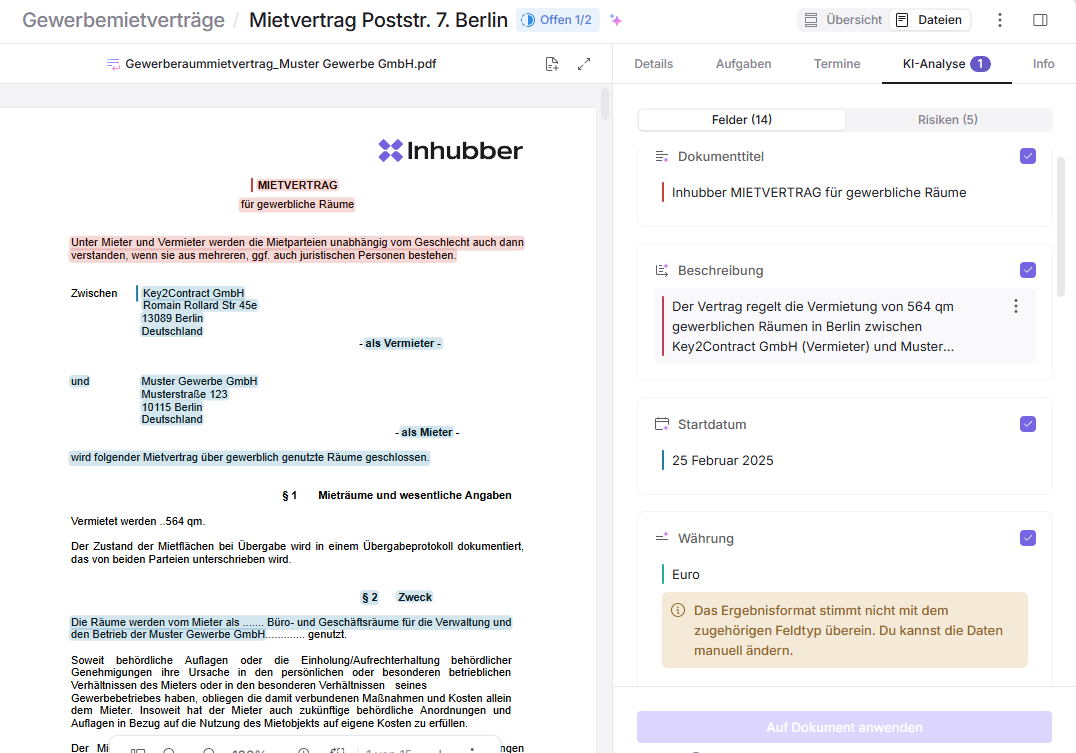
Once contract data is captured digitally and structured, deadlines and follow-up processes can be managed automatically. Termination dates, renewal periods, reminders, or internal review processes no longer need to be tracked manually but are identified and monitored by the system.
This significantly reduces the workload for teams in their day-to-day operations. Instead of manually reviewing contracts or maintaining calendar lists, responsible individuals automatically receive tasks and reminders. As a result, important deadlines become not only more visible but also easier to manage operationally.
At apetito, this benefit is particularly evident: automated workflows have reduced manual administrative effort and made it much more efficient to manage large volumes of contracts.
Value: Less manual tracking, fewer sources of error, and greater process reliability across all contract-related tasks.
Structured Contract Data
Another key advantage of digital systems is that contracts are no longer stored merely as files, but as structured data sets. Relevant information such as contract terms, termination dates, counterparties, responsibilities, and specific conditions is transferred into defined fields, making it comparable and easy to analyze.
This forms the foundation for professional contract management. Only when contract data is structured can it be systematically filtered, evaluated, and managed consistently across the organization. At the same time, this improves data quality and reduces ambiguity in interpretation.
This is especially critical for companies with large volumes of similar or recurring contracts, as it enables a consistent and reliable overview of all agreements and obligations.
Value: Improved data quality, greater comparability, and a reliable foundation for both operational and strategic decision-making.
Improved Assessment of Risks and Contract Content
Digital contract management not only creates structure but also enhances the ability to assess contract content more effectively. Relevant clauses, obligations, special terms, and critical provisions become visible and can be reviewed in a more targeted way.
This is particularly important in the food service industry, where contracts often include complex conditions related to pricing, delivery obligations, quality standards, or liability. When this information is systematically captured and presented, risks can be identified earlier and evaluated more accurately.
As a result, the role of contract management evolves. It is no longer limited to document storage and deadline tracking, but becomes an active function focused on managing contracts based on their actual content.
Value: Greater control over contract content, better decision-making, and earlier identification of critical contractual elements.
Scalability Across Multiple Locations
In the food service industry, contract processes often need to be managed consistently across multiple locations. This is where decentralized or purely manual approaches quickly reach their limits. Digital contract management provides a standardized framework that remains effective even as the organization grows.
Contracts can be captured, reviewed, and managed according to the same rules across the entire organization. This not only ensures consistency but also reduces coordination efforts between departments, locations, and central functions.
This is particularly critical for larger organizations, as it enables the creation of a scalable contract management structure that can grow alongside the business.
Value: Standardized processes, improved control across multiple locations, and a solid foundation for sustainable growth.
Increased Efficiency Through Automation and Workflows
In addition to improved structure, digital contract management primarily enables more efficient processes.
Standardized templates reduce the effort required for recurring contracts. New agreements can be created more quickly while ensuring consistency across the organization.
Contract-related tasks—such as review, creation, or approval—can be assigned in a targeted manner. Responsible individuals are automatically notified, ensuring that processes move forward without delays.
Escalation mechanisms ensure that tasks are not overlooked. If deadlines are missed, additional stakeholders are automatically informed.
Automated reminders further help keep track of key dates and obligations.
Result: More stable processes, reduced coordination effort, and significantly higher efficiency.
The Role of AI in Contract Management
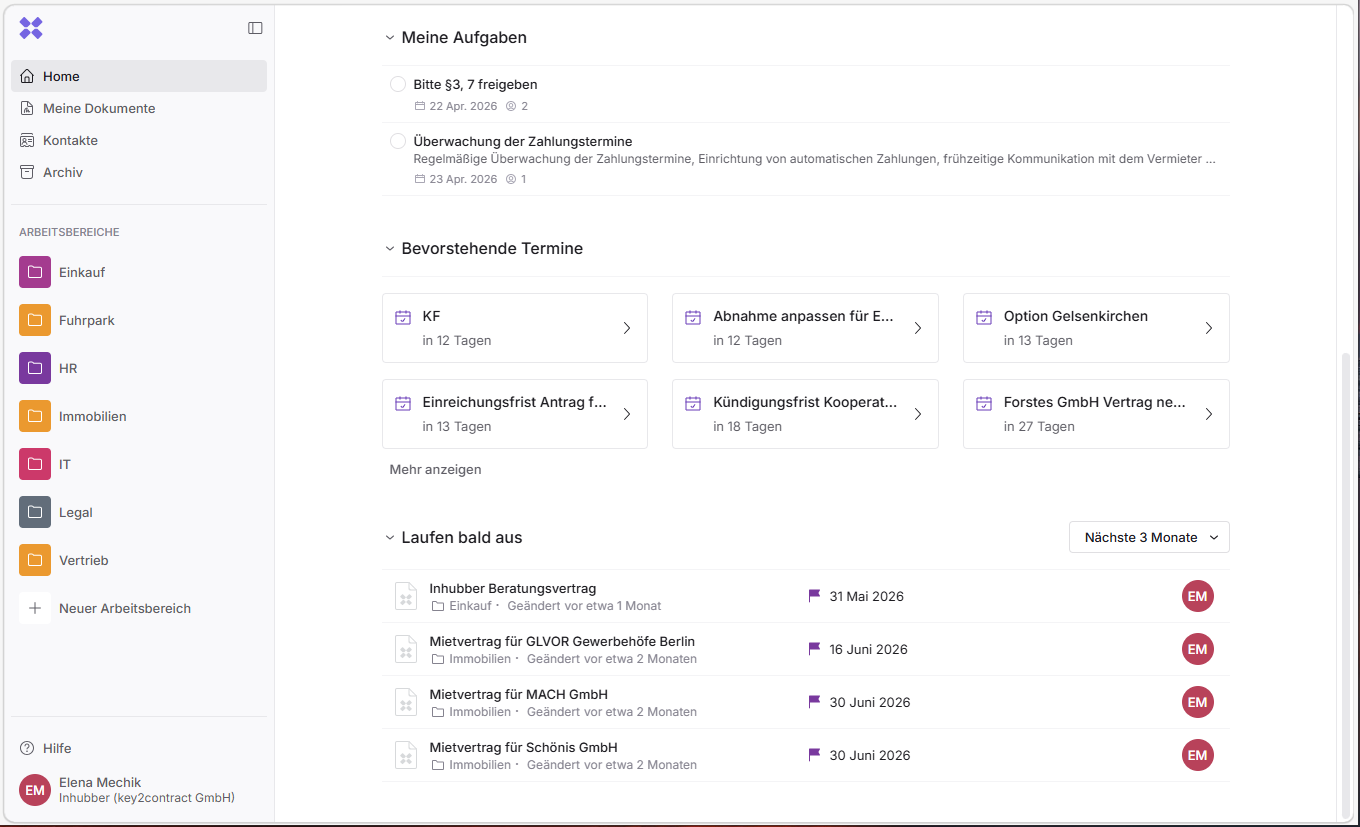
Artificial intelligence enables the automated analysis of large volumes of contracts.
Contracts can be evaluated automatically, relevant information extracted, and potential risks identified. This significantly reduces the need for manual review.
Another key advantage is comparability: contracts can be analyzed in a consistent way and easily compared with one another.
This is particularly relevant for companies managing large contract portfolios.
Contract Management in Practice: Real-World Use Cases
The true value of digital contract management becomes most apparent in day-to-day operations. This is where it determines whether contracts are easily accessible, processes run smoothly, and information can actually be used for decision-making. Especially in the food service industry—with numerous suppliers, documents, and stakeholders—clear benefits emerge in specific, well-defined use cases.
Integration of Existing Contracts (Including OCR)
In many companies, the challenge lies not only in managing new contracts but also in handling historically accumulated contract portfolios. Older contracts often exist in paper form, as scanned documents, or in inconsistent file formats. Without digital processing, these documents remain difficult to use and cannot be managed systematically.
With digital solutions, existing and scanned contracts can be integrated and processed using OCR (optical character recognition) technology. This not only digitizes the documents but also makes their contents accessible in a structured format. As a result, even older contracts can be incorporated into ongoing contract management processes.
For companies like apetito, which have built up large volumes of contracts over many years, this step is essential. Historical documents are transformed from passive archives into actively usable sources of information.
Value: Existing contract portfolios become centrally manageable, analyzable, and operationally usable.
Fast Access to Contract Information
In day-to-day operations, information often needs to be available at short notice. Whether it concerns delivery terms, contract durations, responsibilities, or specific clauses, employees should not have to search through multiple folders, emails, or systems.
A digital contract management platform enables fast, location-independent access to all relevant contract information. Contracts are centrally stored, searchable, and immediately accessible to authorized users. This significantly reduces response times in operational processes.
This use case is particularly important in decentralized structures such as EDEKA Foodservice. When multiple locations or departments need access to the same information, fast and consistent availability becomes a critical efficiency factor.
Value: Less time spent searching, faster response times, and improved collaboration across locations and departments.
Transparency Over Obligations and Contract Terms
Contracts do not only include deadlines but also a wide range of operationally relevant content: pricing agreements, scopes of service, service levels, purchase commitments, and liability clauses. In practice, these elements are critical, as they directly impact costs, processes, and collaboration with partners.
Digital contract management makes this information more visible and easier to analyze. Obligations and terms can be captured in a structured way, reviewed more efficiently, and analyzed when needed. This makes it easier not only to manage contracts formally but also to actively control them based on their content.
This is especially valuable in complex supplier contracts in the food service industry. Companies gain a stronger foundation to meet obligations, identify deviations early, and manage contract relationships more proactively.
Value: Greater clarity over financially and operationally relevant contract content, as well as improved control over ongoing obligations.
Verträge als steuerbare Prozesse
Der vielleicht wichtigste Anwendungsfall besteht darin, dass Verträge nicht länger als statische Dokumente betrachtet werden, sondern als Bestandteil aktiver Geschäftsprozesse. Sobald Vertragsinhalte, Fristen, Aufgaben und Zuständigkeiten digital verknüpft sind, entstehen steuerbare Abläufe statt isolierter Dokumentenverwaltung.
Das betrifft zum Beispiel die Prüfung neuer Verträge, Freigabeprozesse, Verlängerungsentscheidungen oder die Überwachung laufender Verpflichtungen. Verträge werden damit in operative Routinen eingebunden und können systematisch nachverfolgt werden.
Genau darin liegt der strategische Mehrwert digitaler Vertragsverwaltung: Aus einzelnen Dokumenten wird ein steuerbares System, das Transparenz, Verbindlichkeit und operative Umsetzbarkeit miteinander verbindet.
Mehrwert: Mehr Kontrolle über Abläufe, höhere Verlässlichkeit in der Umsetzung und ein Vertragsmanagement, das aktiv zur Unternehmenssteuerung beiträgt.
Conclusion: Contract Management as a Strategic Success Factor
Contract management in the food service industry is increasingly evolving into a strategic management tool.
Digital and AI-powered solutions enable companies to manage contracts efficiently, automate processes, and make well-informed decisions.
As a result, organizations gain not only greater visibility but also the ability to actively manage their contract landscape and build sustainable competitive advantages over time.