
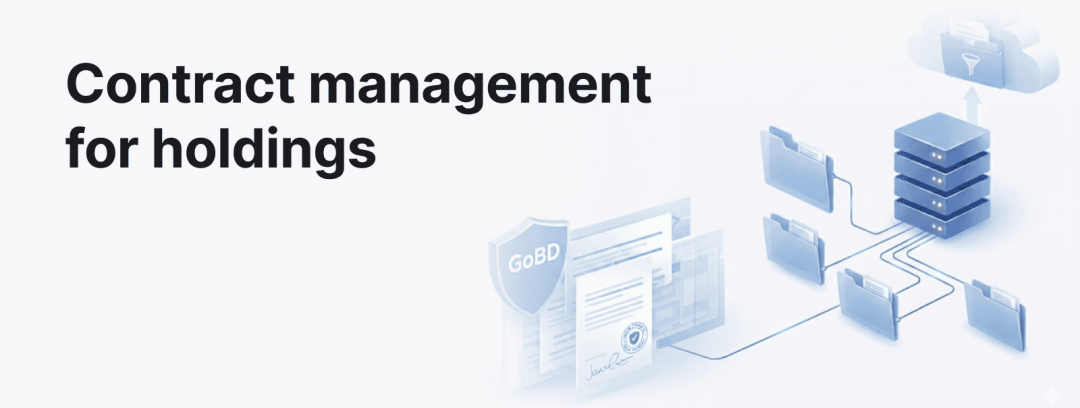
In holding companies and corporate groups, contracts are often scattered across shared drives, email inboxes, and the systems of different subsidiaries. Without centralized contract management, there is often a lack of transparency around notice periods, clear responsibilities, and controlled access rights. Multi-tenant contract management software helps organize contracts across different legal entities centrally while keeping confidential information separate.
For CFOs, procurement leaders, and digital transformation managers, cross-entity contract management is an important foundation for governance, risk control, and efficient processes. This article explains how holding companies can manage contract deadlines, permissions, and approvals across multiple subsidiaries and which features suitable software should provide. A practical example is available at Inhubber.com.
Why contract management across multiple subsidiaries is particularly complex
While individual companies may still manage contracts using Excel spreadsheets and file folders, holding companies require structured contract management across multiple entities. Key challenges include maintaining the legal separation of subsidiaries, working with different IT systems, and meeting growing compliance requirements.
Legally Separate Entities with Interconnected Operations:
Each subsidiary is a separate legal entity, with its own set of contracts, approval processes and responsibilities. At the same time, individual contracts often have repercussions across the whole corporate group, since they may involve several companies and departments.
Digital Maturity Across Different Levels:
Each company acquired comes with its own IT environment. One subsidiary might use SharePoint, another local file storage, and a third might still use paper records. Therefore, at the beginning there is almost never a central repository for all contract types.
Growing Demands of Compliance
As organizations grow, so do their regulatory requirements. These range from the GDPR-compliant processing of personal data and audit-proof document retention under GoBD to the information security requirements introduced by NIS2. If an auditor asks to see the contract records, they want to see a complete and transparent record for each company in the group.
Without a central structure, each new subsidiary increases the risk of missing deadlines and a lack of transparency in audits. These are exactly the types of contract risks that an effective contract management solution for holdings is designed to mitigate. Moreover, without strong contract governance it is difficult to put in place clear responsibilities across the organisation.
A holding company has multiple entities. How can it do contracts for all of them from a single system?
A good way to start is with one source of truth, i.e. a central contract repository that will store all the contracts of all companies in the group no matter where they were created. This allows organisations to manage contracts digitally rather than having to sift through disparate storage locations.
This does not mean that each company has to surrender its independence. The format is well structured and follows the hierarchy of the corporation. Each contract is clearly associated to a particular subsidiary or business unit. At the same time, the holding company monitors the whole life cycle of every contract.
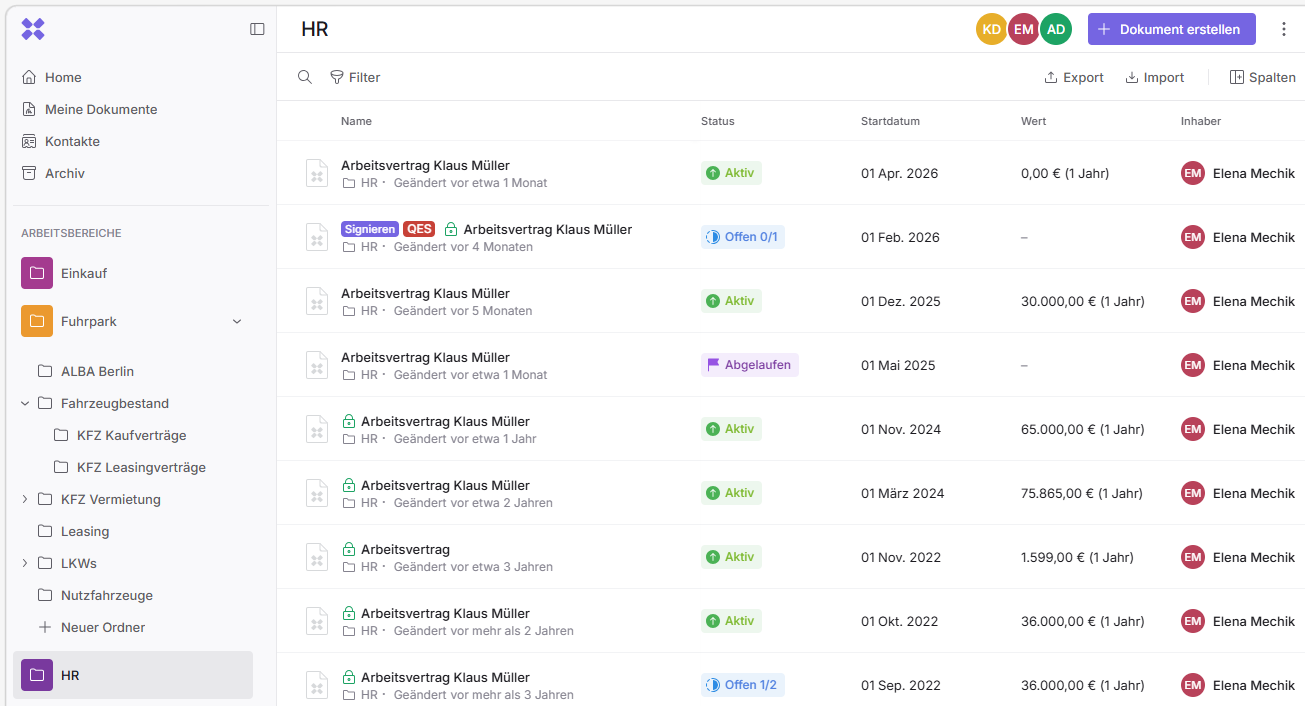
Normally, implementation is done in three phases. First, existing contracts are migrated into a digital contract management system, where AI-powered metadata extraction helps identify contract parties, terms, and termination dates automatically. Then each subsidiary gets its own workspace, while group-wide framework agreements remain centrally available. Finally, responsible users are onboarded, so each company can manage its own contracts while the holding company retains control over governance policies.
Best contract management software for holdings and corporate groups
Not every Contract Lifecycle Management (CLM) solution is built for corporate groups. For complex holding structures, a CLM platform needs to include company-wide workflow automation and advanced approval processes.
One of the most important requirements is multi-tenancy. This means that the contract management software can accommodate several legally independent entities on one platform, while the data of each entity is strictly separated. The following features are required for holding companies and corporate groups:
- Multi-tenancy with fine-grained access control: A company can only view its own contracts, unless it has company-wide access.
- Consolidated reporting: The holding company should be able to produce consolidated reports across all the subsidiaries (for example contract volume or high-risk clauses) without having to jump around the workspaces of the individual companies.
- Integration with existing business systems: The platform should be able to integrate with existing business systems, such as SAP or other ERP or CRM systems, and with Microsoft Entra ID or Active Directory for Single Sign-On . Contract data never needs to be maintained more than once.
- Scalability: The software should be able to grow with the organization, adding new subsidiaries but without adding separate systems or more complexity.”
- Certified information security: For sensitive documents such as employment contracts, M&A agreements or supplier contracts, ISO 27001 certification should be the minimum security standard.
Today’s contract management software does far more than store contracts. It also automates approval workflows, and the processes of contract creation and termination. Additionally, these solutions can be customized to meet the unique requirements of industries such as public sector contract management, where procurement regulations and documentation requirements are particularly stringent.
How to set access rights in holdings contract management
Any multi-tenant contract management system is based on access rights. The principle we use here is Role Based Access Control, or RBAC. Rather than giving access to individual users, access is given based on predefined roles such as “Managing Director – Subsidiary A”, “Group Procurement” or “Holding Legal”.
The typical arrangement of access rights in a corporate group is in the following layers:
- Company level: Employees working in the subsidiary can only view contracts in their own company.
- Group level: Central departments like Legal, Compliance or Finance have read or write access to multiple or all companies within the group, depending on their responsibilities.
- Project-based access: M&A due diligence processes may require temporary access to certain categories of contracts, on a project-by-project basis, protecting sensitive information while allowing for efficient collaboration.
In case of integration between the contract management platform and an existing identity management solution such as Microsoft Entra ID or Active Directory via Single Sign-On (SSO), user permissions are synced to the HR system automatically. If an employee leaves the company , access is revoked centrally , not manually removed from multiple systems . This drastically decreases security risks as manual permissions can easily become out of date.
How to automate contract deadlines for multiple companies
One of the priciest contract management mistakes is missed deadlines for termination, especially when framework agreements are automatically renewed for 12 or 24 months. With hundreds – even thousands – of active contracts in a corporate group, manual deadline tracking is simply no longer reliable.
Multi-level reminder workflows handle automated deadline management. When a contract is added the system automatically determines the key dates and notifies the responsible person 90, 60 and 30 days before the deadline. If no action is taken, it is escalated to the next management level. In a holding structure these escalation rules can be defined centrally for the whole group, the respective subsidiary is responsible for each contract.
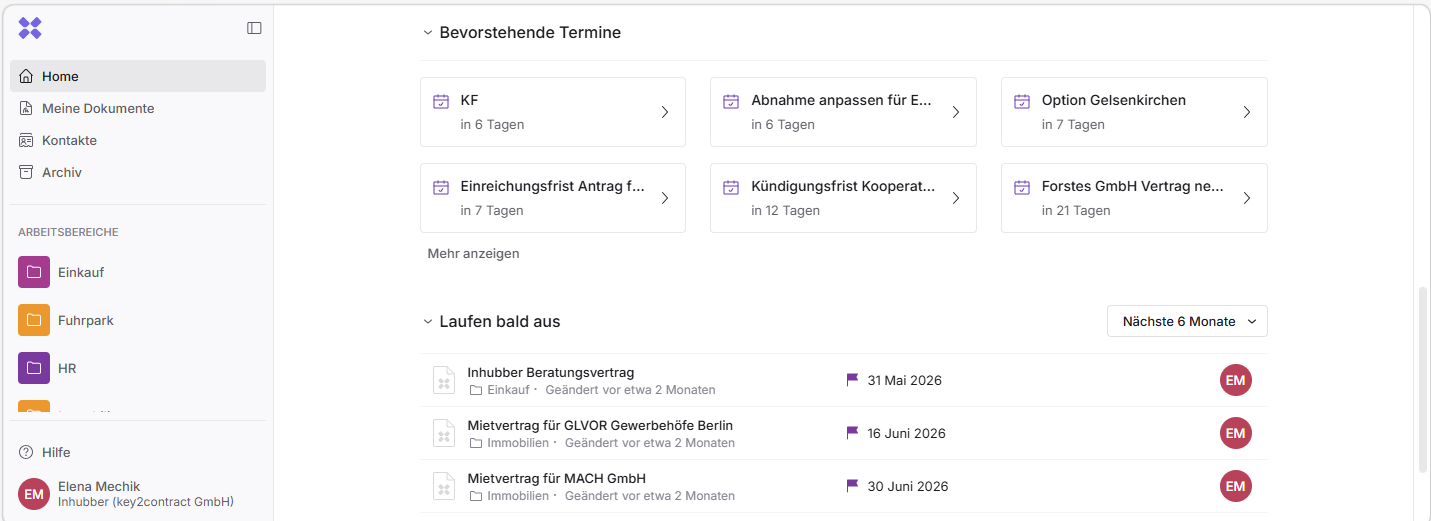
For corporate management, a consolidated overview is particularly valuable. The holding company can see at a glance all contracts about to expire in the next six or 12 months for each company in the group, so it can spot early opportunities for negotiations. For example, if several subsidiaries are due to renew similar supplier agreements, the organization can negotiate one group‐wide framework agreement instead of renewing each contract separately.
How can AI assist with contract management in holding structures?
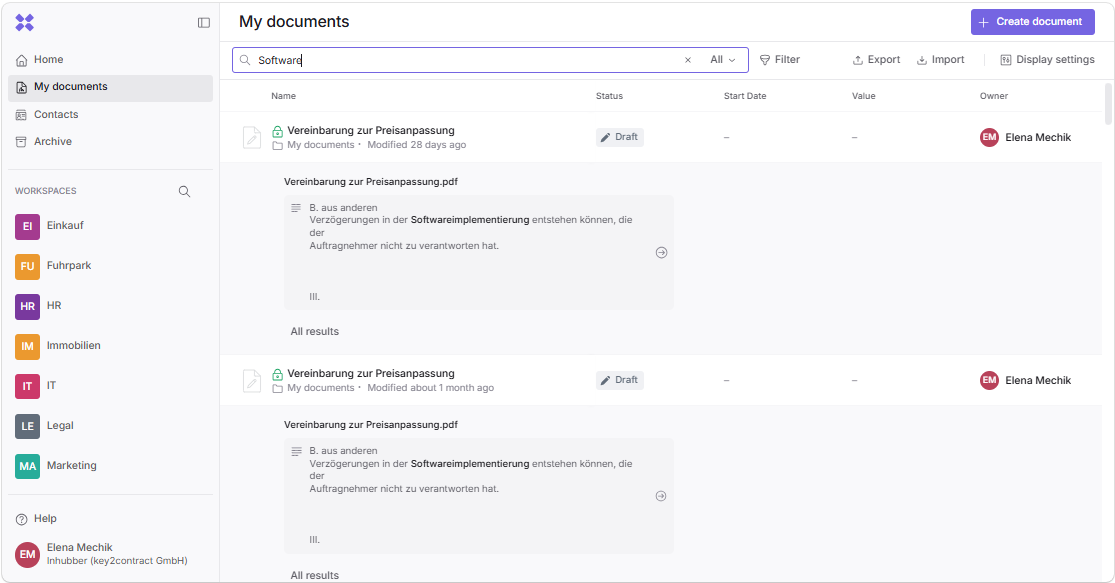
Corporate groups are using AI-powered document analysis to transform how large contract portfolios are managed. “Artificial intelligence can extract key metadata automatically, instead of manually sifting through every contract. This includes who the parties to the contract are, the terms, termination dates and contract values, making all this information searchable in seconds.”
AI delivers value to the parent companies in three primary ways:
Old contracts are going faster: If you’re building a centralized contract management system, or you’re inheriting hundreds of legacy contracts in the wake of an acquisition, AI-powered data extraction will make the migration process go by leaps and bounds. Search imported contracts instantly, no more wasted time on data entry.
Risk Identification in a lot of companies: It can also review contracts to see if there are any dangerous clauses in there – like no limit on liability or weird penalty clauses – and assess the risk that poses for the entire corporate family. This allows legal teams to determine common themes across subsidiaries instead of analysing contracts in isolation, helping to mitigate risks before they become expensive problems.
Integration after a merger: After an acquisition the contract portfolio of the acquired company has to be reviewed and integrated in the contract structure of the group. AI-assisted analysis can identify duplicate agreements, upcoming contract expiry and inherited risks much faster than a manual review.
Important to keep in mind that AI is not a replacement for legal expertise or legal review. Instead it provides a clear and strong basis for decision making that supports the foregoing analysis.
What compliance requirements apply to contract management in corporate groups?
In corporate groups, contract management has to comply with a multitude of regulatory requirements, and these can only be met with a structured way of managing contracts.
Under the General Data Protection Regulation (GDPR), personal data of employees, customers or business partners are often found in contracts. This management of data must be documented uniformly for all companies in the group with clear retention and deletion policies for expired contracts.
GoBD requirements apply to tax-relevant documents. Records must be maintained in a way that is tamper-proof, traceable and fully auditable. This is why any enterprise contract management system has an integral thorough audit trail that logs every change made to a contract.
ISO 27001, the globally recognised standard for information security management systems, has become an important selection criteria when dealing with sensitive corporate documents such as M&A agreements, employment contracts or confidential supplier agreements. Read more about Inhubber’s security standards in our dedicated Security section.
Organizations operating in critical or highly regulated industries will also have to comply with new and enhanced cybersecurity requirements introduced by NIS2, making information security an important factor when selecting contract management software. In addition, companies entering into contracts between legal entities in different EU member states frequently require qualified electronic signatures (QES) under the eIDAS Regulation to guarantee cross-border legal validity.
A full audit trail is the foundation for evidencing compliance in an audit and for providing the transparency needed for good corporate governance. Today, contract data is increasingly expected by supervisory boards and executive management to be part of an organization’s internal control system.
As Dr Elena Mechik, CEO and Co-Founder of Inhubber, says:
“Contract management is not just an administrative job anymore. For corporate groups, it is central to compliance, governance and risk management. Organizations that know exactly who has access to which contracts, what deadlines are coming up and where potential risks exist lay the groundwork for safe and efficient corporate management.”
Corporate structure and holding of Inhubber support
Inhubber is designed to measure holding companies and corporate groups. It is a multi-tenant contract management platform, each subsidiary has its own workspace and folder structure, but the group-wide framework agreements are also centrally available with role-based access control.
It also provides a complete audit trail of all contract changes, Single Sign-On (SSO) via Microsoft Entra ID and integration with ERP and CRM systems such as SAP. This means contract data only needs to be stored in one place, rather than across multiple systems. AI-enabled document analysis automatically extracts metadata and flags potentially risky clauses, accelerating the migration of existing contracts and ongoing contract reviews. Customizable contract templates also make it possible to create recurring arrangements for the entire corporate group. A practical example of this is demonstrated in the Ansorge contract management case study .
Also centralized vendor management and supplier management helps because it enables comparison, analysis and consolidation of supplier contracts from various subsidiaries in one place.
Inhubber (key2contract GmbH) is certified according to ISO/IEC 27001:2022 Certificate No. DE-IS-2026028B issued by Proks Certification GmbH, Düsseldorf, accredited by DAkkS (D-ZM-21201-01-00) and valid until 26 May 2029.
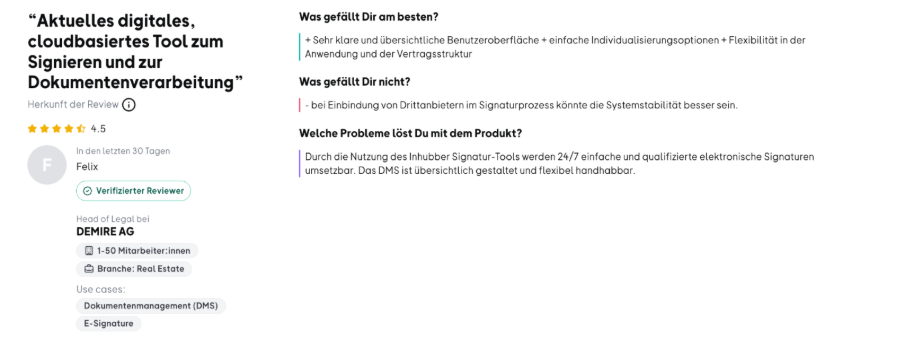
Independent reviews also back OMR Reviews. Users say the best things about Inhubber are its intuitive interface, its central repository of contracts and its automated deadline reminders.
Will contract management software keep pace with a growing holding company?
Corporation structures are always evolving. New subsidiaries are created or purchased, others may be combined or sold. If a contract management solution only works with the current structure of the organization, it will quickly become a constraint as the business grows.
In the long run, to scale, as a contract management platform it needs the following abilities:
- Unlimited workspaces and tenants to add new subsidiaries without having to have different licensing tiers or a new system.
- Standardized onboarding processes for new acquisitions that allow for integration in weeks not months.
- API integrations to connect the current systems of acquired companies, eliminating the need to migrate data manually.
- Flexible role and permission models that can easily accommodate changes in reporting structures, responsibilities and organizational hierarchies across the corporate group.
Contract management: A strategic function in corporate groups
Contract management is still viewed by many large organizations primarily as an administrative task, with each subsidiary managing its own contracts with little standardization. However, the rise of compliance requirements, greater risk management responsibilities and the need for improved corporate governance have made contract management a strategic business function that links contract oversight with day-to-day operational management.
CFOs, Procurement Leaders and executive management can depend on a centralized, multi-tenant contract repository with clearly defined access rights, automated deadline monitoring and a full audit trail to provide reliable, real-time insights whenever they need them. Organizations that put this foundation in place early mitigate operational risk and ensure they can respond quickly to business growth, acquisitions and organizational changes.
Want to know how you can map your own corporate structure inside a centralized contract management platform? Book a demo with Inhubber. We’ll show you how a multi-tenant environment can be adapted to your holding structure and your individual subsidiaries.
FAQs (Frequently Asked Questions)
What does multi-tenancy mean in contract management?
Multi-tenant contract management software allows multiple independent legal entities (e.g. subsidiaries of a holding company) to utilize the same platform and keep their data separate. Companies have their own contracts, users and permissions, but the central teams still have visibility and oversight of the whole corporate group.
How do you manage contracts through your various subsidiaries?
Best approach is a central contract repository with dedicated workspaces for each company, role based access control and group level consolidated reporting. This makes possible a centralized control with the subsidiaries operating independently.
What is the best conglomeration contract management software?
The best solutions offer true multi-tenancy, fine-grained access control, smooth integration with ERP and CRM systems, and certified information security standards such as ISO 27001.
Are you responsible for managing the access rights of a holding company?
In most cases the access rights are handled using Role Based Access Control (RBAC) where the permissions are assigned to the roles defined, instead of the users directly. It also integrates with Microsoft Entra ID or Active Directory to keep user permissions automatically synchronized and up to date.
What is an audit trail?
An audit trail is a complete record of all activity on a contract. It shows who opened the contract, what changes were made and when. Transparency is critical in audits and regulatory inspections.
Looking for ISO 27001 accredited contract management software?
ISO 27001 certification is not a legal requirement. This is the de facto industry standard for information security when dealing with highly sensitive documents such as M&A agreements, employment contracts or confidential supplier agreements.
How does it automatically monitor contract deadlines?
The system also automatically identifies key contract dates and sends reminders (i.e., 90, 60 and 30 days in advance of a termination or renewal date). Notifications can be escalated through pre-defined workflows if no action is taken.
Are contracts amenable to automated analysis by AI?
Yes. AI-driven document analysis automatically extracts key metadata such as contract parties, contract terms and termination dates and flags risky clauses. The final legal determination should always be made by qualified legal professionals.
How long will it take to put in place
How fast you can implement depends on how many subsidiaries you have and how many contracts. With AI-powered metadata extraction and automated migration, many organizations can have a centralized contract management system up and running in weeks.
Existing contracts may be migrated automatically.
Yup Bulk import of contracts from other repositories is supported. During migration AI extracts the required meta data automatically. This reduces manual work a lot and speeds up implementation.
Is it possible to host more than 100 companies on a single Inhubber platform?
Yeah. Inhubber is designed to handle a large number of workspaces, tenants. The API integrations make it very easy to integrate the platform even in complex corporate and holding structures.
FAQ
A corporate group can consolidate contracts in one repository while keeping each legal entity organizationally separated. Inhubber supports dedicated workspaces, roles, and permissions per entity together with an aggregated view for the holding company, finance, procurement, or management.
For multiple legal entities, contracts should be clearly assigned to the correct entity and permissions should reflect that structure. Inhubber maps entities, responsibilities, and access rights in one platform without removing the operational separation between them.
Recurring approvals and tasks can be structured in Inhubber by legal entity, contract type, or responsibility. This connects local review steps with group-wide governance requirements while keeping contract status traceable across all involved entities.
Corporate groups can assign access rights by legal entity, role, department, or area of responsibility. Inhubber supports granular, role-based permissions so that sensitive contracts are only visible to authorized users, while central functions can be granted group-wide access when needed.
Contract deadlines can be managed centrally and assigned to the relevant entities and owners. Automated reminders help local teams and central functions track termination, renewal, and other critical dates across the group.