



Put your contract workflows on autopilot




in Germany

certified

encrypted
Trusted by over 10000 happy users


-
 Upload any contractUpload one or many — just drag, drop, and you’re done.
 -
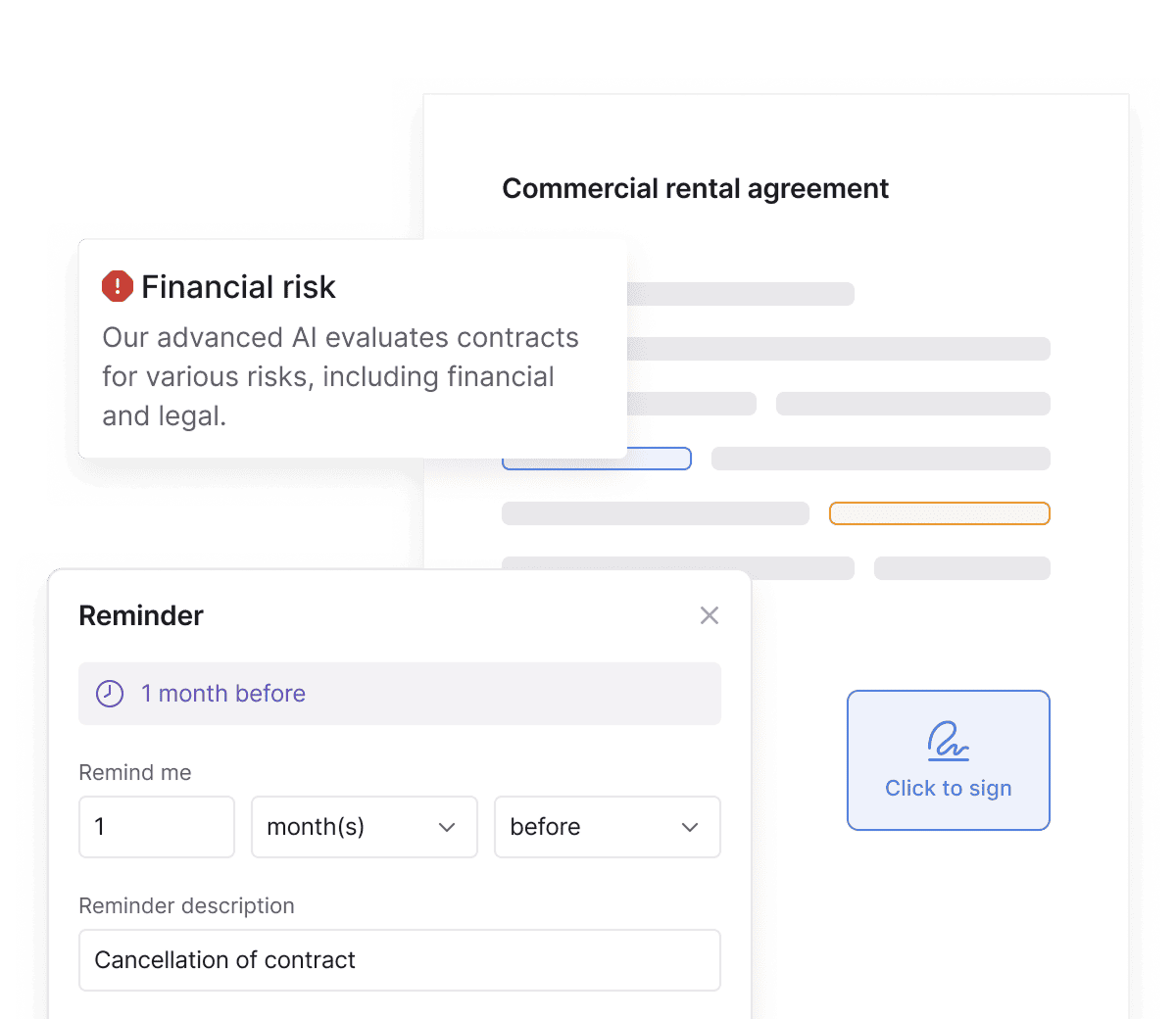
 AI analyses every wordAI analyzes deadlines, risks, renewal clauses, payment terms — Inhubber highlights them for quick action.
 -
 Auto-generate smart remindersInhubber creates a timeline of key events and sends smart reminders before it’s too late.
 -
 Get notified. EverywhereReceive real-time alerts via email. Instantly sync with your calendar—so your team never misses a key event.
 -
 Assign your teamLoop in legal, finance, or project leads with custom reminder roles and responsibilities.
Automate recurring contract processes
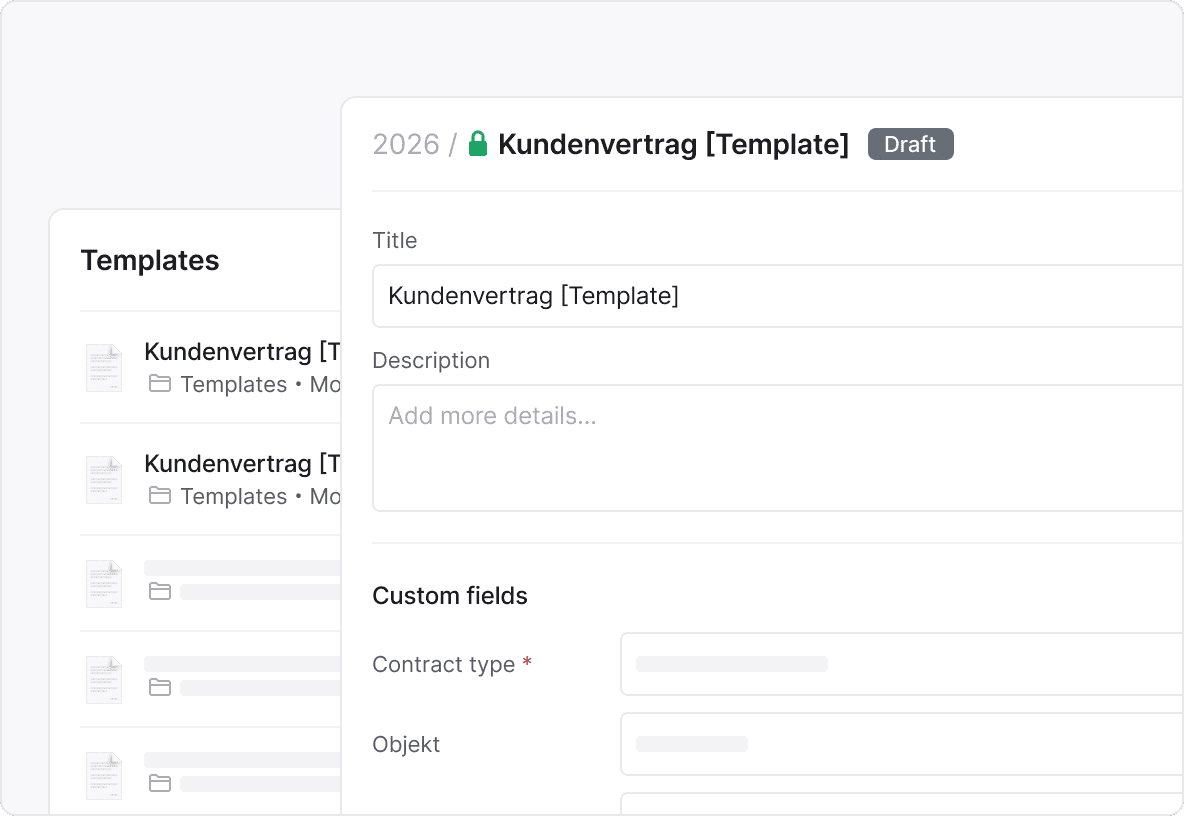
Approval workflows that fit your teams
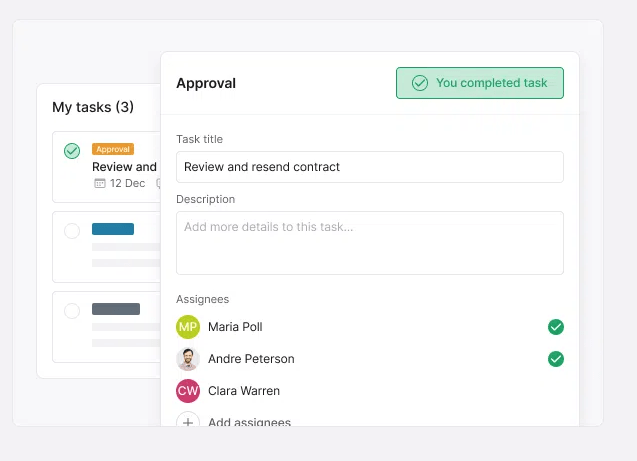
Manage statuses, deadlines, and tasks in one place
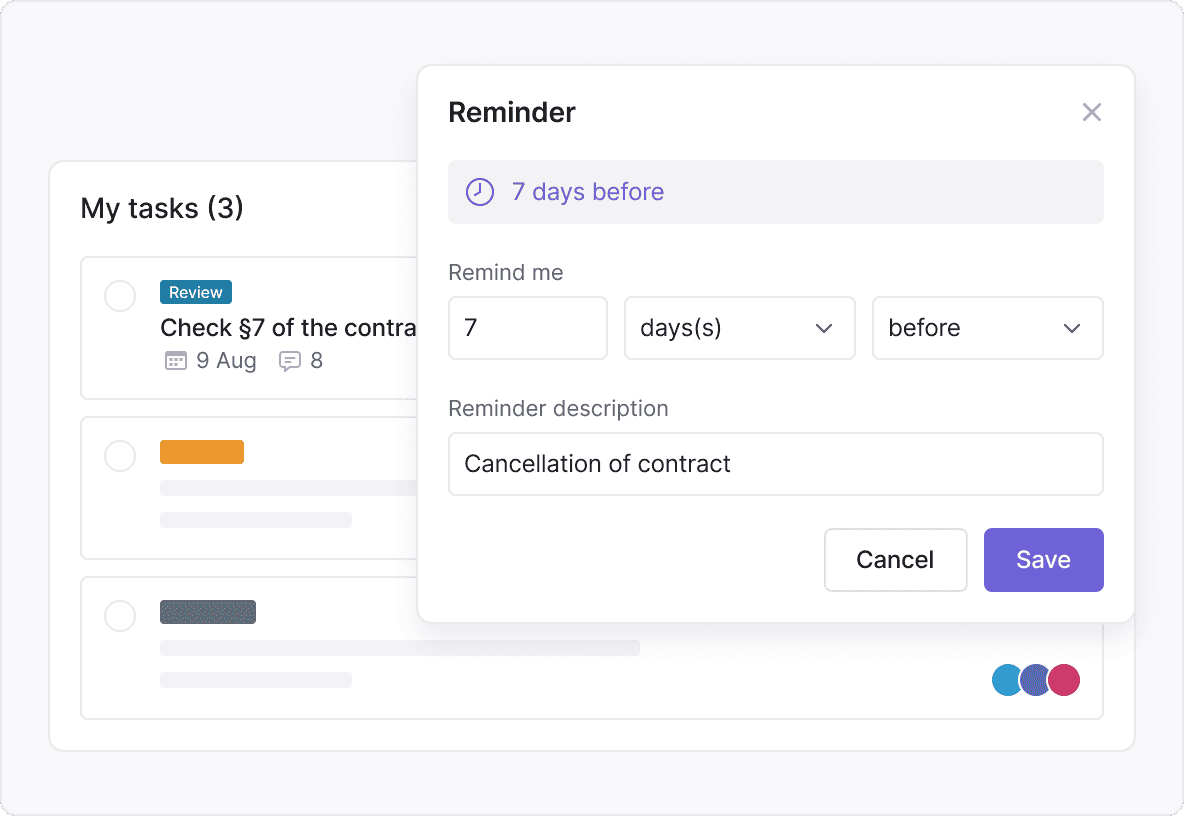
The right workflow for every document type
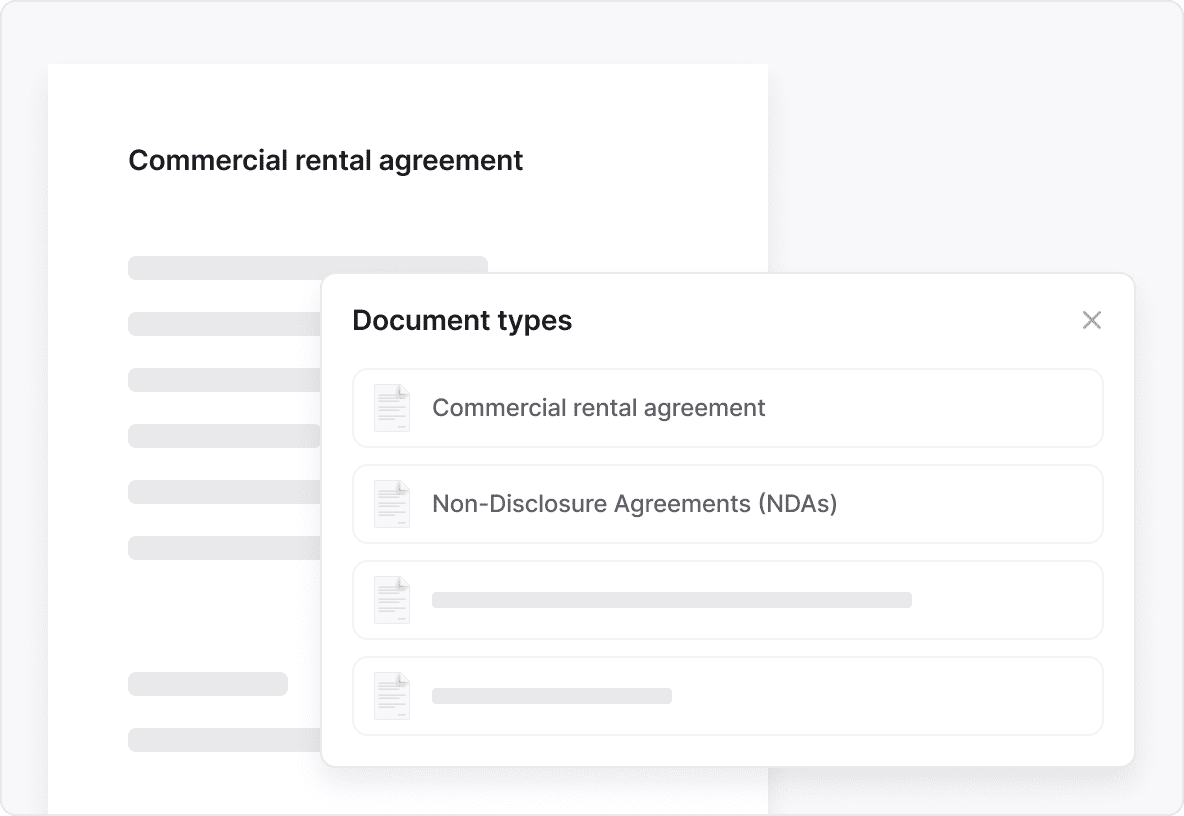
Features for automated contract workflows


“Powerfully simple”
 Automatic deadline monitoring is a real game changer for us. We used to manage deadlines manually in Excel spreadsheets, which was naturally error-prone. Now Inhubber ensures that we are notified in a timely manner about upcoming termination periods. This has already saved us from unnecessary costs.
Automatic deadline monitoring is a real game changer for us. We used to manage deadlines manually in Excel, which was error-prone. Now Inhubber notifies us in time about upcoming termination periods, helping us avoid missed deadlines and unnecessary costs.
Automatic deadline monitoring is a real game changer for us. We used to manage deadlines manually in Excel spreadsheets, which was naturally error-prone. Now Inhubber ensures that we are notified in a timely manner about upcoming termination periods. This has already saved us from unnecessary costs.
Automatic deadline monitoring is a real game changer for us. We used to manage deadlines manually in Excel, which was error-prone. Now Inhubber notifies us in time about upcoming termination periods, helping us avoid missed deadlines and unnecessary costs.

 Especially in the logistics sector, many contracts are long and complex. With the AI summary, I can understand a 40-page contract in just a few sentences. This saves an incredible amount of time. When I log in in the morning, I immediately see upcoming deadlines, tasks, and signature requests. That way, I know right away what I need to focus on. It used to be much more unclear.
Especially in logistics, contracts are often long and complex. With AI summaries, I can understand a 40-page contract in seconds, saving significant time. Each morning, I instantly see deadlines, tasks, and signature requests—so I know exactly what to focus on.
Especially in the logistics sector, many contracts are long and complex. With the AI summary, I can understand a 40-page contract in just a few sentences. This saves an incredible amount of time. When I log in in the morning, I immediately see upcoming deadlines, tasks, and signature requests. That way, I know right away what I need to focus on. It used to be much more unclear.
Especially in logistics, contracts are often long and complex. With AI summaries, I can understand a 40-page contract in seconds, saving significant time. Each morning, I instantly see deadlines, tasks, and signature requests—so I know exactly what to focus on.

 Inhubber has fundamentally changed the way we handle our contracts by providing a user-friendly and efficient platform that ensures complete transparency. This change has led to significant time savings, particularly through improved organization and accessibility of data. In the financial sector, it is especially useful as it helps keep track of costs and deadlines, making it an essential tool for our sustainable growth.
Inhubber has transformed contract management with a user-friendly platform and full transparency. It saves time through better organization and data access. In finance, it’s valuable for tracking costs and deadlines, supporting growth.
Inhubber has fundamentally changed the way we handle our contracts by providing a user-friendly and efficient platform that ensures complete transparency. This change has led to significant time savings, particularly through improved organization and accessibility of data. In the financial sector, it is especially useful as it helps keep track of costs and deadlines, making it an essential tool for our sustainable growth.
Inhubber has transformed contract management with a user-friendly platform and full transparency. It saves time through better organization and data access. In finance, it’s valuable for tracking costs and deadlines, supporting growth.

 Thanks to Inhubber, it is now much easier and faster to rent out apartments, and I can even rent them out across the country without having to be there.
Thanks to Inhubber, it is now much easier and faster to rent out apartments, and I can even rent them out across the country without having to be there.
Thanks to Inhubber, it is now much easier and faster to rent out apartments, and I can even rent them out across the country without having to be there.

 Before we introduced Inhubber, we missed termination deadlines several times simply because no one remembered that the contract still existed and needed to be cancelled. This led to unnecessary costs that we wanted to avoid. With Inhubber, we can now be confident that this will no longer happen.
Before Inhubber, we missed termination deadlines because contracts were overlooked, leading to unnecessary costs. Now, we’re reliably notified in time and can be confident that deadlines are no longer missed.
Before we introduced Inhubber, we missed termination deadlines several times simply because no one remembered that the contract still existed and needed to be cancelled. This led to unnecessary costs that we wanted to avoid. With Inhubber, we can now be confident that this will no longer happen.
Before Inhubber, we missed termination deadlines because contracts were overlooked, leading to unnecessary costs. Now, we’re reliably notified in time and can be confident that deadlines are no longer missed.

 The advantages I see with Inhubber are, firstly, usability, meaning it’s easy to use for our team members and business partners. The second major advantage I see with Inhubber is the whole issue of data security, data availability, and more.
The advantages I see with Inhubber are, firstly, usability, meaning it’s easy to use for our team members and business partners. The second major advantage I see with Inhubber is the whole issue of data security, data availability, and more.
The advantages I see with Inhubber are, firstly, usability, meaning it’s easy to use for our team members and business partners. The second major advantage I see with Inhubber is the whole issue of data security, data availability, and more.

 After evaluating several software solutions, we chose Inhubber – not only because it offers a web-based solution that’s accessible from anywhere, but also because of the flexibility in structuring contracts. We wanted the option of storing our contracts in clearly structured categories and areas that perfectly fit our organization.
After evaluating several solutions, we chose Inhubber for its web-based accessibility and flexible contract structuring. It allows us to organize contracts into clear categories and areas that perfectly match our organization.
After evaluating several software solutions, we chose Inhubber – not only because it offers a web-based solution that’s accessible from anywhere, but also because of the flexibility in structuring contracts. We wanted the option of storing our contracts in clearly structured categories and areas that perfectly fit our organization.
After evaluating several solutions, we chose Inhubber for its web-based accessibility and flexible contract structuring. It allows us to organize contracts into clear categories and areas that perfectly match our organization.

 Inhubber was the perfect solution for our family-owned business.
We now have a complete overview of all contracts — structured by business units and contract types. Relevant documents are always easy to find, deadlines are automatically tracked, and nothing gets lost anymore.
What impressed us most was the 100% transparency, the ease of use, and the automatic identification of contract risks. Manual effort has been significantly reduced — we save around 80% of the time compared to before.
Inhubber has sustainably professionalized and simplified our contract management.
Inhubber is the perfect solution for our family business. We now have a full overview of all contracts, clearly structured and easy to access. Deadlines are tracked automatically, risks are identified, and manual effort is reduced—saving us around 80% of the time.
Inhubber was the perfect solution for our family-owned business.
We now have a complete overview of all contracts — structured by business units and contract types. Relevant documents are always easy to find, deadlines are automatically tracked, and nothing gets lost anymore.
What impressed us most was the 100% transparency, the ease of use, and the automatic identification of contract risks. Manual effort has been significantly reduced — we save around 80% of the time compared to before.
Inhubber has sustainably professionalized and simplified our contract management.
Inhubber is the perfect solution for our family business. We now have a full overview of all contracts, clearly structured and easy to access. Deadlines are tracked automatically, risks are identified, and manual effort is reduced—saving us around 80% of the time.

 With Inhubber, we now have a central overview of our contracts for the first time and much better control over long-term deadlines. What stands out most is how intuitive the system is: responsibilities are clearer, contracts are easier to find, and relevant information is available in a structured way. Inhubber makes professional contract management simple — and I would clearly recommend it to other municipal utilities.
With Inhubber, we have a central overview of our contracts and much better control over deadlines. The intuitive system creates clearer responsibilities, makes contracts easier to find, and noticeably simplifies our day-to-day work.
With Inhubber, we now have a central overview of our contracts for the first time and much better control over long-term deadlines. What stands out most is how intuitive the system is: responsibilities are clearer, contracts are easier to find, and relevant information is available in a structured way. Inhubber makes professional contract management simple — and I would clearly recommend it to other municipal utilities.
With Inhubber, we have a central overview of our contracts and much better control over deadlines. The intuitive system creates clearer responsibilities, makes contracts easier to find, and noticeably simplifies our day-to-day work.

 With Inhubber, we now have a clear central structure for our contracts, deadlines, and responsibilities. The system is easy to use, flexible enough to support our different departments, and helps us find contract information much faster. Automated deadline tracking and clearly defined access rights also make our day-to-day contract work more reliable and much easier to manage.
With Inhubber, we now have a clear central structure for our contracts, deadlines, and responsibilities. The system is easy to use, flexible enough for our different departments, and makes everyday contract work noticeably faster and more reliable.
With Inhubber, we now have a clear central structure for our contracts, deadlines, and responsibilities. The system is easy to use, flexible enough to support our different departments, and helps us find contract information much faster. Automated deadline tracking and clearly defined access rights also make our day-to-day contract work more reliable and much easier to manage.
With Inhubber, we now have a clear central structure for our contracts, deadlines, and responsibilities. The system is easy to use, flexible enough for our different departments, and makes everyday contract work noticeably faster and more reliable.





Award winning CLM software






FAQ
Picture the journey a contract takes through your company: Legal reviews it, a manager approves it, procurement picks up a task, and somewhere along the way a deadline comes due. An automated contract workflow maps that journey once, digitally — every stage, every owner. The difference is hard to miss: no one has to coordinate each step by email or across scattered tools anymore. Inhubber turns these recurring processes into a clear structure, so everyone on the team knows when it’s their turn and what comes next. And the more contracts you manage, the bigger the payoff: fewer alignment loops, more consistent processes — and a lot more calm in your workflow.
The real work happens once — at the start. You map out the steps your contracts go through again and again: tasks, reviews, approvals, status changes, deadlines. Then you set them up in Inhubber, and the system takes it from there. The moment a contract reaches a certain point in the process, the next step kicks off automatically. No one has to stop and figure out who’s up next — the workflow already knows. And because no two companies work the same way, workflows adapt to your responsibilities and contract types. They shine brightest on standardized processes that follow the same pattern every time: from drafting or review to final approval, you get one clear, reliable flow.
Anything that repeats — managing, reviewing, and approving contracts. In practice, that means things like tasks assigned to specific team members, internal approvals, status changes, or deadlines and reminders that run right inside the process. Multi-step flows across departments work too: a contract might go to procurement first, then to Legal, with final sign-off from management. Which steps you need depends on your organization and the document type. And here’s what matters to us: the goal isn’t to force every contract into the same rigid mold. It’s to standardize your recurring processes so they fit the way your teams actually work.
Yes — and this is where a good workflow solution proves itself. An employment contract simply moves through different stations than a supplier, lease, or framework agreement. That’s why Inhubber lets you connect each document type to the right workflow: you decide which people or departments review and approve at each stage, and in what order. The result: standardized processes without treating every contract the same. For larger organizations especially, this makes all the difference — different internal flows each get their place, while your entire contract management still runs on one central platform.
Conditional approvals follow a simple logic: an approval step only triggers when predefined conditions are met. Here’s an example: most contracts run through your standard flow — but the moment a contract goes through a specific internal process or requires special sign-off, an extra review step slots in automatically. The upside is obvious: you don’t have to build a separate process for every exception, and you don’t have to push every contract through the same rigid flow either. With Inhubber, you map these decision paths along your internal responsibilities. It’s especially valuable wherever contracts need different approval levels depending on their type or process: your workflow stays standardized — and still responds to the situation at hand.
Yes. Many contract workflows in Inhubber are configured right in the interface — typically with a few clicks, no code required. It sounds like a small thing, but in daily work it changes everything: you adjust processes yourself, without launching a development project for every change. Responsibilities, tasks, approvals, and other process steps get defined the way your organization actually operates. And since companies evolve, that flexibility is exactly what counts: a new owner, an extra review step, a changed approval path — adjustments like these should be simple, not the outcome of an IT project. That’s how you standardize and automate your contract processes step by step, without rebuilding existing workflows from scratch.
When contract management eats up time, it’s rarely the contract itself — it’s the coordination around it. Who’s already reviewed this? Where’s that approval? Who do I still need to remind? Those questions are where the day actually goes. Automated workflows take that organizational load off your plate, because owners and process steps are locked in from the start. Everyone involved can see what’s due and where the contract goes next — no chasing, no reminder emails. And recurring processes don’t need to be re-organized for every single contract. The higher your contract volume and the more departments involved, the more you’ll feel it: less busywork, more consistent processes — and more time for the work that actually matters.
A contract is rarely just “in progress” — it’s under review, waiting for approval, or already signed and done. In Inhubber, that status is part of the workflow itself: you always see exactly where a contract stands, and you manage deadlines and reminders in one central place. Here’s the key part: this information no longer lives scattered across individual inboxes or personal calendars where only one person can see it. Your whole team works from the same picture. That pays off most on contracts that run for weeks or months and pass through many hands — where one step finished on time often decides whether the entire process stays on schedule.
Think of an audit trail as your contract process’s memory: it documents what happened around a contract, and when — from reviews to approvals to changes. Why does that matter? Because especially with internal reviews and approvals, you should be able to trace later exactly how a contract moved through the process. Inhubber keeps relevant activities structured and traceable — useful for team collaboration and compliance processes alike. The practical difference: instead of piecing together approvals and changes from email threads and file versions, you find everything in one place. Anyone who wants to understand a contract’s history only needs one look.
In short: any company where contracts regularly pass through several hands — across procurement, Legal, Finance, HR, or multiple management levels. A simple rule of thumb: the more contracts you handle and the more often processes repeat, the more you get out of standardization. Working with many different contract types? Even more reason to take a look — because every document type can get its own matching workflow. Inhubber adapts to your internal structures, not the other way around: tasks, approvals, statuses, and deadlines all come together on one central platform. Growing companies and large organizations benefit alike — both gain structure and traceability across their contract management.