
When I talk to CEOs, finance executives, or legal teams about digital contract management, sooner or later, a very reasonable question comes up:
“What is the actual financial benefit for our business?”
I consider this question more important than any discussion about individual software features.
Companies don’t invest in contract management just to get a better-looking digital archive. They invest because they want to waste less time, manage risks more effectively, and make better business decisions.
Yet the return on investment (ROI) of contract management software is often presented in an overly simplified way.
Someone calculates the minutes saved when searching for contracts, multiplies them by an hourly rate, and arrives at an impressive number.
That can be a starting point. But it isn’t a complete business case.
In practice, the financial value of digital contract management comes from several areas at once: everyday operations, contract deadlines, approval processes, negotiations, and better visibility into existing obligations.
And not every benefit can immediately be translated into euros.
That’s why I want to explain how companies can calculate ROI realistically — and which factors are often overlooked.
1. What Does ROI in Contract Management Actually Mean?
Return on Investment measures the relationship between the financial benefits of an investment and its costs.
For a Contract Lifecycle Management (CLM) platform, the question is whether the savings and additional financial benefits generated by the software exceed the costs of implementation, use, and ongoing operation.
The basic formula is:
ROI = (Financial Benefits − Total Costs) / Total Costs × 100
An ROI of 100%, for example, means that the calculated net benefit equals the investment costs.
The time period matters.
Implementing software may involve additional expenses in the first year, while its benefits develop over several years.
That’s why I recommend calculating ROI for both the first year and a three-year period.
It’s also important to distinguish between three types of benefits:
Direct cost savings: Expenses that are actually eliminated or reduced.
Productivity gains: Working hours that become available for other tasks.
Risk reduction: Potential financial losses whose likelihood or impact is reduced.
These categories shouldn’t simply be treated as equivalent in a business case.
For example, saving one hour of work doesn’t automatically mean personnel costs decrease by one hour.
Often, the real benefit is that employees can handle more tasks with the same resources.
2. The Hidden Costs of Manual Contract Management
When companies evaluate their contract management processes, they often start with the most obvious costs: software licenses, employee hours, or external legal advice.
But the biggest inefficiencies are often hidden in everyday operations.
Someone searches for a contract because nobody knows which folder contains the latest version.
The legal department is asked to review an agreement again, even though a similar contract was already reviewed months ago.
The finance department discovers an automatic renewal too late.
A contract waits several days for approval because it’s unclear who needs to make the next decision.
Or an employee leaves the company, taking important knowledge about contractual arrangements with them.
Each of these situations may seem relatively minor on its own.
But in companies managing hundreds or thousands of contracts, these inefficiencies add up.
Five cost areas are particularly relevant:
- Time spent searching, reviewing, and manually entering contract information
- Costs caused by missed deadlines and unwanted renewals
- Coordination effort for approvals and signatures
- Limited visibility into obligations and contract terms
- Additional work during audits, reviews, and internal controls
For me, the key question isn’t just how much contract administration costs today.
It’s also this:
What costs arise because contracts aren’t being managed systematically?
3. Time Savings: The Most Visible, but Not Always the Biggest ROI Factor
Time savings are usually the easiest starting point for an ROI calculation.
Companies can measure how long employees need to find a contract, extract important information, or prepare a contract overview.
Let’s take a simplified example.
A company has 20 employees who regularly work with contracts.
Each employee spends an average of 15 minutes per working day searching for documents, contract information, or the latest processing status.
With 220 working days per year, the calculation looks like this:
20 employees × 0.25 hours × 220 days = 1,100 hours per year
Assuming internal fully loaded personnel costs of €50 per hour, this represents a calculated time value of €55,000 annually.
Of course, no software will eliminate all search time.
But if centralized storage, structured documents, and AI-powered analysis reduce this time by 40%, the calculated productivity gain would be €22,000 per year.
This is not a guaranteed saving. It’s an illustrative scenario.
And even this figure needs to be interpreted correctly: the €22,000 initially represents working capacity that has become available, not necessarily a corresponding reduction in personnel costs.
The actual financial benefit depends on how the company uses that capacity.
Perhaps the legal department can review more contracts without hiring additional employees.
Perhaps procurement can spend more time negotiating better terms.
Or the finance department can reduce the number of manual follow-up requests it needs to handle.
For me, this is an important difference between an attractive ROI presentation and a business case that actually stands up to scrutiny.
4. Contract Deadlines: Small Oversights Can Lead to Significant Costs
Another important financial factor is contract renewals, termination deadlines, and contractual obligations.
Many companies don’t have complete visibility into their ongoing contractual costs.
Contracts are spread across different departments. Some renew automatically. Others contain price adjustment clauses, minimum purchase commitments, or specific termination conditions.
When this information isn’t centrally available, financial decisions are often made too late.
Imagine a company with 300 active supplier and service contracts.
If just five contracts are renewed unnecessarily, and each renewal creates €4,000 in avoidable costs, the company faces €20,000 in additional expenses.
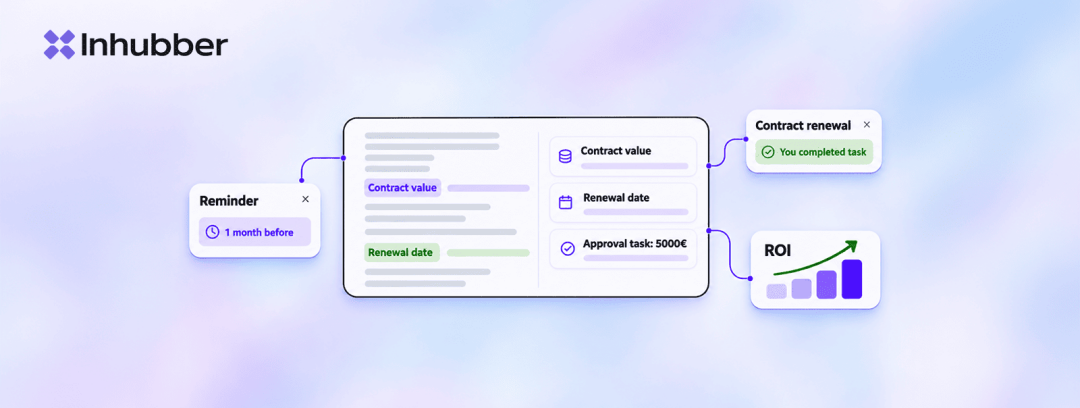
Centralized contract management with automated reminders can help identify these situations early.
But an important distinction applies here as well:
Not every automatic renewal is a bad thing.
Some contracts should deliberately be continued. Others may contain favorable terms that could be lost during renegotiation.
The financial value doesn’t come from terminating as many contracts as possible.
It comes from being able to make decisions at the right time.
Good contract management doesn’t prevent every renewal. It prevents renewals from happening unnoticed.
5. AI in Contract Management: ROI Doesn’t Come from AI Alone
Artificial intelligence is often presented as the main reason to digitalize contract processes.
I see AI as an important productivity tool, but not as an end in itself.
Its financial value comes from reducing specific manual tasks.
For example, extracting termination deadlines, contract durations, and important clauses.
Or summarizing lengthy contract documents.
Inhubber supports AI-powered contract analysis, helping employees identify relevant information more quickly.
This can be especially valuable when a company is digitalizing a large existing contract portfolio or regularly reviewing complex agreements.
However, two factors should be considered when calculating ROI.
First, AI-generated results must be appropriately reviewed when legally or financially significant decisions are involved.
Second, the actual time savings depend heavily on document quality, contract complexity, and the workflow itself.
A realistic business case therefore measures more than how quickly AI can extract information.
It also accounts for the time needed to review, correct, and process the results.
The right question isn’t:
“How much AI do we have?”
It’s:
“Which specific tasks can we complete faster and more reliably with AI?”
6. Digital Approvals: When Waiting Costs More Than Reviewing
One particularly underestimated cost factor is contract approvals.
In many companies, several departments must approve an agreement before it can be signed.
Legal reviews the legal risks. Finance evaluates the financial implications. Procurement checks supplier terms. Management may need to provide final approval.
When these processes are organized through email, delays quickly arise.
Who worked on the contract last?
Which approval is still missing?
Has the latest change already been agreed upon with the external contract partner?
And is the contract even ready to be signed?
Inhubber allows companies to define flexible approval workflows based on document type.
Organizations can establish mandatory approvals. For example, both Legal and Finance may need to approve a contract before the electronic signature process can begin.
External contract partners can also be involved in discussions and coordination, with controls over which communications are visible to which participants.
Once the process is complete, there is a record of who approved what and when.
The financial value appears on several levels.
Employees spend less time following up.
Contract processes become more transparent.
Missing approvals can be identified before signing.
And when questions arise later, it’s possible to understand why certain decisions were made.
Not every one of these benefits can immediately be expressed as a cost saving.
But especially in complex or recurring contract processes, their overall impact can be significant.
7. Electronic Signatures: It’s Not Just About Saving Paper and Postage
When companies think about electronic signatures, they often focus first on reducing printing, shipping, and archiving costs.
That’s reasonable, but it’s often not the biggest advantage.
A more important benefit may be that contracts can be completed faster, with fewer manual handovers.
When review, approval, and electronic signing take place within one connected process, documents no longer need to be constantly transferred between different systems.
With Inhubber, the signature process can be linked to predefined approval requirements.
This creates a controlled workflow from contract review through to signing.
For ROI calculations, it’s important to distinguish between direct savings and the financial effects of shorter processing times.
A faster signature doesn’t automatically generate additional revenue.
But it may have financial value if projects can start earlier, customers can be onboarded sooner, or internal resources remain tied up for less time.
Such effects should only be assigned a monetary value when the company can measure them reliably.
8. A Practical ROI Example: What Could Digital Contract Management Save a Mid-Sized Company?
Let’s consider a hypothetical mid-sized company with several departments, 1,500 active contracts, and regular contract reviews.
The following figures are illustrative assumptions, not measured results from Inhubber customers.
Annual Financial Benefits
| Source of Benefit | Assumed Annual Value |
|---|---|
| Reduced search and administrative time | €22,000 |
| Fewer avoidable contract renewals | €15,000 |
| Reduced review and approval effort | €12,000 |
| Less manual work related to signatures | €4,000 |
| Total Calculated Benefits | €53,000 |
Annual Costs
| Cost Category | Assumed Value |
|---|---|
| Software license | €18,000 |
| Implementation and training, allocated to the first year | €8,000 |
| Internal operation and maintenance | €4,000 |
| Total First-Year Costs | €30,000 |
This gives us:
ROI = (€53,000 − €30,000) / €30,000 × 100 = approximately 77%
The calculated net benefit in this example is €23,000 in the first year.
However, the calculation includes estimated productivity gains. It should therefore not be interpreted as a guaranteed additional cash flow of €23,000.
For a conservative assessment, the company should also separate actual avoided expenses from working hours made available for other tasks.
What could a similar calculation look like for your company? Schedule a consultation and explore the potential savings in your contract processes with our team.
When Does the Investment Pay for Itself?
In this simplified scenario, the average monthly benefit is approximately €4,417.
The payback period depends on when implementation costs occur, how the software license is billed, and how quickly the benefits are realized.
With benefits and costs distributed evenly over time, the calculation indicates payback within the first year.
For reliable financial planning, however, I recommend looking at monthly cash flow and how benefits develop over time rather than relying on a single generalized payback figure.
9. Three Scenarios Instead of One Optimistic ROI Figure
I recommend that companies calculate more than one ROI scenario.
In practice, adoption of a new platform rarely develops exactly as planned.
A conservative scenario assumes a slower rollout, smaller time savings, and fewer avoided contract costs.
A realistic scenario reflects expected adoption after a reasonable implementation period.
An optimistic scenario illustrates the potential benefits if the platform is widely adopted and existing processes are consistently improved.
Let’s use annual costs of €30,000 for our example:
| Scenario | Financial Benefits | ROI |
|---|---|---|
| Conservative | €25,000 | −17% |
| Realistic | €53,000 | 77% |
| Optimistic | €75,000 | 150% |
These figures are illustrative examples.
Above all, they demonstrate one thing:
ROI depends not only on the software itself, but also on how consistently a company uses it to improve its processes.
10. Which KPIs Should Companies Measure?
Anyone who wants to assess the ROI of contract management software needs a baseline.
Before implementing a new platform, companies should therefore measure several key performance indicators.
These include:
- Average time required to find a contract
- Time spent extracting important contract information
- Average duration of contract reviews and approvals
- Percentage of contracts with fully documented approvals
- Number of missed termination and renewal deadlines
- Costs of avoidable contract renewals
- Percentage of contracts centrally recorded and actively managed
- Number of manual handovers between review, approval, and signing
- Time spent responding to audit and compliance requests
- Adoption and usage rate of the contract management platform
The important part is to measure these KPIs using the same methodology before and after implementation.
Companies should also distinguish between improvements directly attributable to the new software and those resulting from other organizational changes.
11. Which Costs Belong in a Complete CLM Business Case?
A realistic ROI calculation must account for more than the software license.
Implementation, data migration, training, internal project work, and ongoing maintenance all require resources.
Relevant costs include:
Software costs: Licenses, users, modules, and any additional services.
Implementation: Platform setup, permissions, document structures, and approval workflows.
Migration: Reviewing, cleaning up, and transferring existing contracts.
Training: Onboarding employees and adapting internal working methods.
Operations: Ongoing management of users, processes, and contract information.
Change management: Time and resources needed to integrate the platform into everyday operations over the long term.
A business case doesn’t become stronger by ignoring these costs.
It becomes stronger when they are planned realistically.
12. Which Contract Management Software Delivers the Highest ROI?
There is no credible way to answer this question with a single product name.
A platform with a large number of features may deliver less financial value than a simpler solution if employees rarely use it.
Conversely, a powerful CLM platform can deliver significant benefits when it brings together processes that were previously handled in separate systems.
For companies managing many contracts across multiple departments, I consider the following capabilities particularly important:
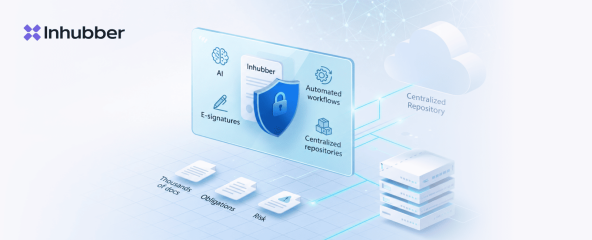
Centralized contract management, AI-powered analysis, automated deadline reminders, flexible approval workflows, electronic signatures, and traceable documentation.
Bringing these capabilities together is a key part of Inhubber’s approach.
Our goal isn’t to sell companies as many features as possible.
We want to help them simplify contract processes and make better use of financially relevant information.
Whether Inhubber delivers the highest ROI in a specific situation should be evaluated based on the company’s contract portfolio, processes, requirements, and total costs.
Have questions about Inhubber’s features, use cases, or pricing? Contact our team. We’ll be happy to help you find the right solution for your requirements.
13. When Is Contract Management Software Particularly Worthwhile?
In my experience, taking a closer look at a CLM platform is especially worthwhile when several of the following situations apply.
Contracts are distributed across different departments and systems.
Important contract information is regularly searched for manually.
Termination deadlines and renewals are tracked through spreadsheets or personal reminders.
Multiple departments are involved in contract approvals.
External contract partners need to participate in reviews or negotiations.
Contract decisions are difficult to reconstruct later.
Or the number of contracts is growing faster than the available administrative resources.
The more of these challenges a company faces, the greater the potential financial value of an integrated platform.
For a company with very few contracts that rarely change, however, a simpler solution may be perfectly sufficient.
That, too, is part of an objective ROI assessment.
14. How Companies Can Build a Reliable ROI Business Case
I would start with a manageable pilot project.
For example, supplier contracts in the procurement department or customer contracts within a specific business unit.
First, measure how long searching, reviewing, approving, and signing currently take.
Then identify the most common problems: missed deadlines, unclear responsibilities, duplicated work, or limited transparency.
Based on these findings, define specific improvement goals.
The next step is to test the software with real contracts and actual employees.
After an initial implementation period, measure the same KPIs again.
This creates a more reliable basis for decision-making than general promises about supposed time savings.
For me, the best proof of ROI isn’t the highest percentage in a presentation.
It’s the moment when a company can use its own data to demonstrate that a previously time-consuming process now works measurably better.
Want to understand the potential financial impact of digital contract management for your business? Book a personal consultation and discuss the key factors for your individual ROI calculation with our team.
15. My Conclusion: The Greatest ROI Comes from Better Decisions
Digital contract management is often viewed primarily as an efficiency project.
That’s correct, but in my view, it doesn’t go far enough.
Contracts determine which obligations a company takes on, which costs arise, which services must be delivered, and which business opportunities exist.
When that information isn’t accessible, companies lack an important foundation for sound decisions.
The financial value therefore comes from more than helping employees find contracts faster.
It also comes from enabling companies to make timely renewal decisions, control approvals, identify risks, and better understand their contractual obligations.
For me, the central question isn’t simply:
“How much does contract management software cost us?”
It’s also:
“What does it cost us to continue managing our contracts without a systematic approach?”
Both questions belong in a good business case.
And only by considering them together can companies make an informed investment decision.
FAQ
The software with the highest ROI depends on contract volume, process complexity, adoption, and total costs. Inhubber combines centralized contract management, AI-powered analysis, deadline tracking, approvals, and electronic signatures.
The actual ROI should be calculated using company-specific KPIs. Schedule a consultation to explore your company’s potential savings together with our team.
There is no universally applicable ROI figure. In an illustrative scenario with €53,000 in annual benefits and €30,000 in costs, the ROI is approximately 77%. Actual results may vary significantly.
Digital contract management can be particularly valuable for companies managing large numbers of contracts, multiple departments, and recurring approval processes. The decisive factor is whether the savings and productivity gains exceed the total costs.
ROI is calculated by subtracting total costs from the financial benefits, dividing the result by total costs, and multiplying by 100. Direct savings, productivity gains, and risk reduction should be assessed separately.
That depends on the specific tasks involved. Inhubber supports AI-powered analysis of contract content. Actual time savings should be measured using real documents, including the time required for quality checks and validation.
In addition to license fees, costs may include implementation, migration, training, and ongoing maintenance. Potential benefits come from reduced manual work, avoided contractual costs, and more efficient processes.
Inhubber provides automated deadline reminders and centralized contract management. This helps companies review renewals in time and make informed decisions about continuing or terminating agreements.
Key capabilities include centralized contract information, AI-powered analysis, mandatory approvals, deadline reminders, and electronic signatures. Inhubber brings these capabilities together in one platform.
The payback period depends on implementation costs, ongoing expenses, adoption rates, and the benefits actually achieved. A reliable calculation should consider how costs and benefits develop over time.
Inhubber can simplify manual contract searches, deadline tracking, contract reviews, and approval workflows. The financial impact depends on how much time and effort these activities currently require within the organization.
ROI stands for Return on Investment. It measures the relationship between the financial net benefit of a contract management solution and the costs invested in it.
By comparing KPIs before and after implementation, such as contract search times, approval duration, avoided contract costs, manual workload, and the platform’s total costs.
That depends on contract volume, process design, and the existing workload. A reliable estimate is based on measured baseline values and realistic assumptions about potential improvements.
These include time spent searching for documents, duplicated reviews, unclear responsibilities, delayed approvals, missed termination deadlines, and additional audit-related work.
By centrally recording contract durations and termination conditions and setting up timely reminders. Inhubber supports these activities through digital deadline tracking.
AI can accelerate the extraction and evaluation of relevant contract information. The actual productivity gain depends on document quality, complexity, and the level of human review required.
They can reduce manual handovers, follow-up requests, and administrative tasks. This can be particularly valuable in recurring, multi-stage contract processes.
Important KPIs include search time, approval duration, missed deadlines, avoidable renewal costs, contract processing time, platform adoption, and ongoing software expenses.
Start by measuring current costs and process KPIs. Then calculate expected improvements, implementation effort, and ongoing costs. Conservative, realistic, and optimistic scenarios help evaluate the potential return.
Key factors include contract volume, complexity, user adoption, process integration, data quality, actual savings, and total costs over several years.
Calculate the ROI Potential of Your Contract Management
How much time and money could your company save with digital contract management?
Explore the potential savings in your contract processes together with our team.