Secure cloud technology for businesses of all sizes and the public sector: In this interview, Inhubber founders Dr. Elena Mechik and Andre Sokolov explain why blockchain-based integrity verification can be valuable for small and medium-sized enterprises and public institutions — and why modern cybersecurity shouldn’t require complex IT infrastructure.
Contracts are among the most important and sensitive documents an organization handles. They contain confidential pricing, business terms, personal data, and long-term obligations. Yet in many companies, contracts are still exchanged by email, stored in different folders, or managed across multiple systems.
Digital contract management solutions help address these problems. But beyond centralized storage, automated deadline tracking, and electronic signatures, another question arises: How can organizations ensure that confidential documents remain protected and their integrity can be verified over time?
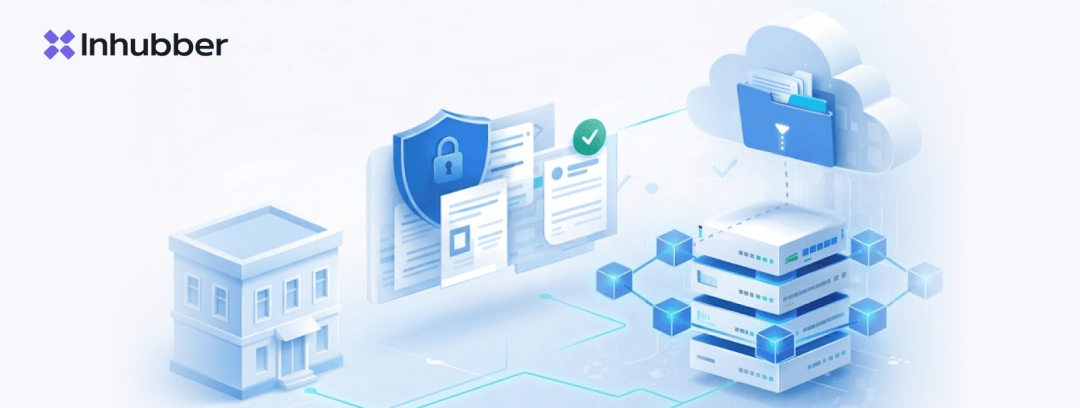
Inhubber combines digital contract management with end-to-end encryption, blockchain-based integrity verification, and an ISO 27001-certified information security management system.
In this interview, the founders discuss common security risks in everyday business operations, the practical value of blockchain technology, and why strong security standards make sense not only for large corporations but also for SMEs and public administrations.
“Cybersecurity Is Not a Question of Company Size.”
Elena, a company recently asked you why it needed modern security technologies just to digitize its contracts. What was your answer?
Dr. Elena Mechik: Yes, that conversation really stayed with me.
A company essentially asked, “We just want to digitize our contracts. Why do we need blockchain and all this cybersecurity?”
And I can understand the question.
When a company starts looking for contract management software, it usually has completely different problems in mind. Contracts are scattered across different locations. Nobody knows exactly which version is current. Cancellation deadlines are tracked in Excel. Finding documents takes too long, and approval processes are slow.
Of course, the company wants to solve these problems first. As quickly and easily as possible.
But I asked a question in return: What is actually in your contracts?
We’re talking about confidential purchase prices, supplier terms, financial obligations, employee information, and strategic business relationships.
Sometimes these documents contain information of considerable economic value.
And a company doesn’t need to manage millions of documents for that information to deserve protection. Just one confidential contract being accessed without authorization or tampered with can cause serious damage.
That’s why I don’t see cybersecurity as an additional feature that only large companies need. To me, it’s one of the fundamental requirements of digital contract management.
Do you think smaller companies are still not sufficiently aware of security risks?
Dr. Elena Mechik: No, I wouldn’t put it that way. I don’t think smaller companies consider security unimportant.
Often, they simply don’t have the time to deal with all the technical details.
The managing director of a medium-sized business has to take care of customers, employees, finances, suppliers, and day-to-day operations. They can’t also be an expert in encryption, blockchain, and IT security.
And they shouldn’t have to be.
Look at online banking. Nobody expects us to configure encryption protocols ourselves before making a bank transfer. We simply expect sensitive transactions to be processed securely.
Why should business software be any different?
That was one of our ideas behind Inhubber: Companies should be able to manage their contracts digitally and easily, while the complex security technology works in the background.
To me, good security is security that employees don’t have to constantly think about in their daily work.
From Research to a Secure SaaS Platform
How did this belief develop into the idea for Inhubber? You both originally came from scientific research and technology development.
Dr. Elena Mechik: Our professional backgrounds were different, but they came together around one shared interest: how digital technologies can solve real problems.
For me, it started with my research into sustainable development and economic relationships.
Among other things, I studied supply chains and spent time in the Brazilian rainforest as part of my scientific work. During that research, I repeatedly saw how difficult it can be to reliably trace information about agreements, transactions, and responsibilities.
At some point, I became increasingly interested in blockchain technology. What fascinated me was the possibility of securing digital records in a way that makes subsequent changes verifiable.
At Humboldt University of Berlin, we then worked on developing this research approach into a practical solution.
And eventually, something became clear: Many of these problems don’t exist only in supply chains.
Companies exchange confidential documents every day, enter into agreements, and sometimes need to establish years later exactly what was agreed upon.
Contracts are a very good example of that.
Andre, you were already working on intelligent information systems at the time. What interested you about the idea?
Andre Sokolov: My background is in business informatics and software development.
I studied at Otto von Guericke University Magdeburg and later worked at Fraunhofer IPK in Berlin on intelligent information systems and the automation of digital processes.
I’ve always been interested in how complex workflows can be organized so that people and systems work together more effectively.
When Elena and I started discussing digital contract management, I realized fairly quickly that it involved much more than a digital folder.
A contract has an entire lifecycle. It’s created, reviewed, approved, negotiated, signed, amended, and eventually renewed or terminated.
And these steps often involve different people, sometimes even several organizations.
At first, that sounds like a classic software problem. But as soon as sensitive information is exchanged, questions about security, access rights, and data integrity come into play.
You have to consider these things from the very beginning when designing the architecture. It doesn’t work particularly well if you try to add security as an extra feature at the very end.
What was the decisive step from research to founding the company?
Dr. Elena Mechik: We wanted to turn our research into something companies could actually use in their daily work.
In 2019, we founded Inhubber together with Leonid. The development was supported, among others, by Humboldt Innovation and the EXIST program.
Our goal was never simply to demonstrate a new technology.
We wanted to solve a concrete problem: Companies should be able to manage their contracts with centralized, secure, and user-friendly contract management software.
Andre Sokolov: And achieving that requires both: a good understanding of business processes and a reliable technical architecture.
A technology can be fascinating. But if it doesn’t make everyday work easier, people ultimately won’t enjoy using it.
Why Secure Cloud Solutions Have Become Essential Business Infrastructure
Many companies already use cloud software for accounting, HR, or collaboration. Why does contract management require particular attention to security?
Andre Sokolov: First of all, every business application should be appropriately protected.
But contracts bring together a particular combination of requirements.
A contract may contain legal, financial, personal, and strategic information. And this information often remains relevant for many years.
A supplier agreement might contain confidential prices or minimum purchase quantities. An employment contract contains personal data. A real estate contract may establish long-term financial obligations.
On top of that, contracts are frequently exchanged between different departments and external parties.
So we’re dealing with several requirements at once.
Information must be available to authorized users. Unauthorized people must not gain access. Changes need to remain traceable.
And with important documents, it may be necessary to verify years later which version existed at a particular point in time.
In information security, we talk about confidentiality, integrity, and availability. Proper access control is another essential part of the picture.
A good contract management solution has to address all these aspects.
What are the advantages of managing contracts in a professional cloud solution rather than on a company’s own server?
Andre Sokolov: Both models can be secure. What matters is how they’re implemented.
Sometimes you hear the argument that an in-house server is automatically safer because the data stays inside the company.
But a server doesn’t become secure just because it’s located in your own building.
Someone has to configure it, update it, monitor it, and maintain it regularly. Security vulnerabilities need to be addressed, access controlled, and systems operated reliably.
Smaller organizations in particular often lack the necessary IT resources.
With a professionally managed SaaS platform, the provider takes responsibility for a significant part of these tasks.
Of course, that doesn’t eliminate all responsibilities on the customer’s side. User permissions still need to be assigned carefully, and accounts must be protected.
But the company doesn’t have to develop and operate an entire contract management infrastructure itself.
Dr. Elena Mechik: And that’s an important point for me.
We often talk about how digitalization should make companies more efficient.
But if a medium-sized business first had to hire an additional IT specialist just to operate its contract management software securely, we would have missed that goal.
We want our customers to benefit from a professional cloud solution developed and hosted in Germany without having to launch a major IT project of their own.
Encryption Protects Confidentiality. Blockchain Supports Traceability.
Andre, Inhubber combines end-to-end encryption and blockchain technology. Why did you choose this architecture?
Andre Sokolov: Because the two technologies serve different purposes.
Encryption is primarily about the confidentiality of information.
When a company manages sensitive contract documents in the cloud, those documents need to be protected against unauthorized access.
Blockchain technology addresses a different aspect: the ability to verify the integrity of documents and certain recorded events.
For this, we use cryptographic hash values, among other mechanisms.
Can you explain that in simple terms?
Andre Sokolov: Imagine we have a signed contract as a PDF file.
Using a cryptographic process, we can calculate what’s called a hash value for that file. It’s a kind of digital fingerprint.
If someone changes even a small part of the file’s content, a suitable cryptographic hash function will, with very high probability, produce a different fingerprint.
By comparing the file against a previously secured record, we can check whether it still matches the documented state.
And this is where blockchain can play an additional role.
It makes it possible to protect such records against subsequent tampering and support independent verification.
That doesn’t mean blockchain automatically prevents every form of manipulation. And it doesn’t prove that the content of a contract is legally correct.
But it can help establish whether a document still matches a previously recorded state.
Dr. Elena Mechik: I think this becomes much easier to understand when you look at a real situation.
Let’s take an important supplier agreement.
Several people review different drafts. Then the final version is approved and signed.
Two years later, there’s a disagreement about a particular clause.
Was that clause actually part of the signed version? Or did it appear only in an earlier draft? Does the available file still match the version that was documented at the time?
These aren’t purely theoretical questions. Situations like this can arise in everyday business.
And that’s when it’s helpful to have not only a version history but also an additional way to verify whether a document has remained unchanged.
But a procurement manager doesn’t need to understand how hash algorithms work.
They simply want to find the right contract and know that the information can be verified.
Does every contract really need blockchain?
Andre Sokolov: No, of course not.
Not every digital contract process necessarily requires blockchain technology.
There are other technical ways to ensure integrity and traceability. Digital signatures, protected audit trails, and cryptographic verification methods can also serve important purposes.
So blockchain isn’t automatically the best solution for every problem.
At Inhubber, we deliberately chose an architecture in which blockchain-based records provide an additional mechanism for integrity verification.
But here’s the key point: This technology is already integrated into our platform.
Our customers don’t have to build their own blockchain infrastructure. They don’t have to administer a blockchain or program smart contracts.
They use contract management software.
And the technical security mechanisms work in the background.
“Enterprise-Level Security Shouldn’t Be Reserved for Enterprises.”
Elena, strong IT security is often associated with large companies and complex enterprise systems. Do you think that’s still appropriate?
Dr. Elena Mechik: No, at least not when we’re talking about protecting confidential information.
Of course, large corporations often have more complex organizational structures. They may need numerous integrations, extensive approval workflows, or contract management across several legal entities.
A small company might have much simpler processes.
But does that mean its information deserves less protection?
A family business with 30 employees has trade secrets. A medium-sized supplier has confidential pricing agreements. A small municipality manages service contracts and processes personal data.
All these organizations need appropriate protection for their information.
That’s why I’m not entirely comfortable with the term “enterprise security.”
Sometimes it creates the impression that a high level of security only makes sense for large corporations.
I see it differently. Security should depend on the importance of the information and the actual risks, not on the number of employees.
But isn’t blockchain still too complicated for a small company?
Dr. Elena Mechik: If the company had to develop and operate its own blockchain solution, then probably yes.
But that’s exactly what Inhubber is not about.
A small business might initially just want to manage its contracts centrally, monitor deadlines automatically, and sign documents digitally.
It doesn’t want to launch a second project just to introduce blockchain technology.
And it doesn’t have to.
The security mechanisms are already part of the platform.
For me, that’s the crucial difference: The technology can be sophisticated without making the application complicated.
Andre Sokolov: Exactly. You have to distinguish between the complexity of a technology and the complexity of using it.
We use software every day that’s extremely sophisticated behind the scenes. Yet we expect it to work simply.
Inhubber is no different.
In the background, encryption, user management, version control, and other technical processes have to work together.
But that shouldn’t mean someone has to go through ten steps just to find or approve a contract.
Our job as developers is to abstract that complexity in a sensible way.
And there’s something else I think is important: Blockchain shouldn’t be used just because blockchain exists.
You always have to ask which specific problem it solves.
If the goal is to make the integrity of an important document verifiable over the long term, a blockchain-based record can make sense.
Whether a company has 30 or 30,000 employees isn’t the deciding factor.
Why Cybersecurity Also Matters for Public Administration
Inhubber also works with public institutions. How do their requirements differ from those of private companies?
Dr. Elena Mechik: Public institutions face many of the same challenges as businesses.
They want to digitize administrative processes, find documents more quickly, and improve collaboration between departments.
At the same time, they have particular requirements concerning data protection, documentation, and traceability.
Think about a municipality.
It manages contracts with IT service providers, construction companies, property managers, or maintenance contractors.
Some of these agreements remain in force for many years. And they often involve substantial financial obligations.
In those situations, it’s important that information remains reliably available and verifiable over the long term.
Can blockchain offer a concrete advantage here?
Dr. Elena Mechik: Yes, in certain situations it can.
Imagine a municipality commissions the renovation of a public building.
During the project, there may be amendments to the original agreement, new specifications, or additional signed documents.
A few years later, an audit takes place. And suddenly the question arises: Which version of the contract was applicable at the time?
Of course, the first requirement is complete and well-organized contract documentation.
Blockchain-based integrity records can provide additional support by helping verify whether a particular document still matches its previously recorded state.
To me, this example shows very clearly why such technologies aren’t only relevant to large corporations.
Even a small municipality needs to be able to document its agreements reliably.
But smaller municipalities often have limited staff and tight digitalization budgets. How can they balance these requirements?
Dr. Elena Mechik: That’s exactly why security shouldn’t automatically mean high technical barriers to entry.
A municipality wants to manage its contracts, keep track of deadlines, and see which department is responsible for which process.
It doesn’t want to build its own blockchain environment.
When the relevant security mechanisms are already integrated into a cloud platform, getting started becomes much easier from a technical perspective.
Of course, public institutions still need to assess their legal, organizational, and financial requirements.
But they shouldn’t have to operate a separate technical infrastructure for every security function.
Andre Sokolov: And we shouldn’t forget that blockchain is only one part of the overall security concept.
In public administration, for example, it must be clearly defined who is allowed to see which contracts.
Not every employee needs access to documents from HR, finance, or facility management.
Then there are secure authentication, appropriate permissions, and traceable processes.
Blockchain can’t replace these requirements.
It can make an additional contribution to integrity verification. But information security always depends on several measures working together.
Why User-Friendliness Is Also a Security Factor
Can software still be insecure in everyday use despite strong encryption and modern security technology?
Andre Sokolov: Yes, absolutely.
You can implement excellent cryptographic methods. But if the software is unnecessarily complicated in daily use, new risks emerge elsewhere.
Employees may try to work around cumbersome processes.
They download documents, send files by email, or store information in places where it shouldn’t be stored.
That’s a classic example of what’s known as shadow IT.
That’s why, to me, usability and security belong together.
If an employee can share a contract easily and securely, ideally there’s no need for an unsafe workaround.
If permissions are easy to understand and manage, the risk of accidentally granting too much access is reduced.
And if it’s clear which contract version is current, fewer unnecessary copies are created.
These might sound like small things. But everyday processes like these have a major impact on security in practice.
Dr. Elena Mechik: We see that in our conversations with companies too.
Many customers don’t initially ask about the underlying technology at all.
They want to know: How quickly can we get started? Will our employees need a lot of training? Can we import our existing contracts?
And most importantly: Will this actually make our daily work easier?
Those are absolutely fair questions.
Because what good is the best security technology if employees don’t want to use the software?
That’s why we place so much importance on keeping Inhubber intuitive.
Sophisticated technology should provide the foundation, not become something users have to deal with every day.
Security Doesn’t End with Encryption: ISO 27001, GDPR, and Data Control
What role do security standards and data protection play at Inhubber?
Andre Sokolov: A central role.
Information security isn’t a single feature you switch on and suddenly everything is secure.
You need several layers that work together.
At Inhubber, we follow a multilayered security approach. This includes end-to-end encryption, blockchain-based integrity verification, granular access permissions, and two-factor authentication.
These are complemented by organizational and operational security measures.
ISO 27001 is important in this context because the standard provides a systematic framework for managing information security.
Inhubber is ISO/IEC 27001 certified. This means that defined security processes and controls are established and assessed within the scope of the certification.
For customers, it’s important that the protection of their information doesn’t rely on individual technical features alone.
Dr. Elena Mechik: Another topic that comes up repeatedly in conversations is where data is processed.
Many companies and public institutions want to know exactly where their documents are stored and which rules govern their processing.
Inhubber is developed and hosted in Germany.
Especially when dealing with confidential contract data, companies need to understand how their information is protected and who can access it.
Of course, simply claiming that software is GDPR-compliant isn’t enough.
It also depends on how an organization uses the solution, which data is processed, and how internal processes are structured.
But a provider can establish the necessary technical and organizational foundations.
And I think that’s exactly what companies are right to expect today.
What Companies Should Look for When Choosing Secure Contract Management Software
What questions should managing directors, procurement managers, or IT leaders ask when selecting a contract management solution?
Andre Sokolov: I wouldn’t focus only on a long feature list.
Of course, the software needs to support the required workflows. But you should also understand how it handles confidential information.
How are documents encrypted? Who can access which information? How are changes logged? Can previous document states be verified?
And what security standards apply to the operation of the platform?
If a provider uses blockchain technology, they should be able to explain the specific benefit it delivers.
It’s not enough to say, “We use blockchain, so everything is secure.”
That’s not how information security works.
You need to understand which risks a particular technology addresses and where its limitations are.
Dr. Elena Mechik: I would add two more questions.
The first is: Can our employees actually use the software easily in their daily work?
And the second: What concrete value does it bring to our company?
Because security alone isn’t enough if nobody ends up using the software.
A good solution should help save time, reduce risks, and improve collaboration at the same time.
For example, through automated deadline tracking, clearly organized contract versions, or traceable approval workflows.
To me, these things belong together.
Secure business software shouldn’t just protect data. It should also make a real difference in everyday work.
“Our Goal Was Never to Make Technology More Complicated.”
One final question for both of you: What would you say to companies that consider blockchain in contract management excessive?
Andre Sokolov: First, I’d ask what they mean by excessive.
If a company had to develop, operate, and maintain its own blockchain infrastructure for ten contracts, that would indeed be disproportionate in many cases.
But that’s not our approach.
At Inhubber, blockchain technology is already part of the platform.
Companies don’t have to deal with the underlying technical infrastructure. They use the software for their contract processes and can benefit from the integrated security mechanisms.
Of course, not every contract necessarily needs a blockchain record.
But for important agreements, being able to verify their integrity over the long term can be valuable.
So the real question isn’t whether blockchain is inherently too complicated.
It’s whether the technology solves a concrete problem without creating disproportionate additional effort.
Dr. Elena Mechik: I would put it even more simply.
Why should a small company care less about protecting its contracts than a large corporation?
A medium-sized supplier might depend heavily on a single important customer agreement.
A municipality needs to document its agreements reliably.
And even a family business has information that shouldn’t fall into the wrong hands or be changed without anyone noticing.
So for me, the size of the organization isn’t the decisive criterion.
What matters is how sensitive the information is and what practical benefit a technology actually provides.
When we started Inhubber, we wanted to bring these things together: modern security technology, strong security standards, and an easy-to-use application.
Our customers want to manage their contracts securely, find them quickly, meet deadlines, and collaborate effectively with their teams.
They need a reliable solution for that.
But they shouldn’t have to become blockchain experts first.
That’s our job as a provider, not theirs.
Conclusion: Blockchain Security Is Not a Question of Company Size
Digital contract management is about much more than replacing paper files with electronic documents. Businesses and public institutions need solutions that protect confidential information and make important contract records verifiable over time.
End-to-end encryption helps protect document confidentiality. Blockchain-based integrity verification can provide additional ways to check whether recorded document states remain unchanged. Access permissions, security standards, and organizational measures complement these technical safeguards.
Not every contract necessarily requires blockchain technology. But where long-term integrity verification matters, it can offer concrete additional value.
The important thing is that the technical effort remains proportionate for the organization.
With Inhubber, these security mechanisms are already integrated into a user-friendly, cloud-based contract management platform. Businesses and public institutions don’t have to develop or operate their own blockchain infrastructure.
Modern security shouldn’t be a privilege reserved for large corporations. It should be accessible wherever confidential information needs to remain protected and verifiable.
About the Founders
Dr. Elena Mechik – Co-founder and CEO of Inhubber
Dr. Elena Mechik has spent many years researching sustainable development, economic relationships, and how digital technologies can create transparency and trust. Her scientific work took her to the Brazilian rainforest, among other places. Her interest in trustworthy information, supply chains, and blockchain technology later helped shape the concept behind Inhubber.
Learn more about Dr. Elena Mechik
Andre Sokolov – Co-founder and CTO of Inhubber
Andre Sokolov studied business informatics at Otto von Guericke University Magdeburg and worked at Fraunhofer IPK in Berlin on intelligent information systems and the automation of digital processes. At Inhubber, he combines cybersecurity, scalable software architecture, and intelligent automation with the goal of making complex technology easy to use.
Learn more about Andre Sokolov
Secure Contracts. Verifiable Integrity. Simple Processes.
With Inhubber, businesses and public institutions can manage contracts centrally, track deadlines automatically, analyze documents with AI, and sign agreements digitally — all on a cloud platform developed and hosted in Germany, with integrated security mechanisms.
Discover how simple secure contract management can be.
Book a Demo with Inhubber