
AI. Automated workflows. E-signatures. Centralized repositories. Today’s contract management conversation is dominated by technology. But behind every feature that helps companies analyze thousands of documents, track obligations, and flag risk, there’s a more fundamental set of questions:
How do you make a complex system transparent?
How do you build trust between parties who may sit in different companies, countries, and legal systems?
How do you pin down who’s accountable for what?
How do you prove that critical information hasn’t been quietly altered?
And how do you turn scattered data into a foundation for better decisions?
For Inhubber, these questions predate the platform itself. They trace back to the doctoral research of co-founder and CEO Dr. Elena Mechik — work in sustainable development, natural resource economics, and the management of complex socio-economic systems.
It’s a research path that started with tropical forests and local economies, and wound its way through supply chain transparency, blockchain, digital contract management, and, eventually, AI-powered contract intelligence. It’s proof that a scientific question doesn’t have to end at a journal — it can end up as working software.
From sustainability economics to complex systems research
Before Inhubber, Elena Mechik was a researcher at the University of Hamburg’s Research Unit Sustainability and Global Change.
In 2017, she completed her PhD, “Managing the driver of climate change in the context of sustainable tropical forest management through regulation of economic activities in forest communities while analyzing social-economic interactions.” The dissertation is listed among the group’s doctoral work.
Tropical forests and contract management sound like they have nothing in common. They don’t — not on the surface.
But the real question behind the research was much bigger than forestry.
You can’t separate an ecological system from the economic behavior of the people inside it. Banning things doesn’t protect natural resources — understanding why people make the economic choices they make does. What incentives are they responding to? What resources do they actually have? Who’s accountable when things go wrong?
That systems-level thinking — economic, social, and environmental factors, all interacting — turned out to map directly onto a completely different problem: contract management.
A contract doesn’t exist in a vacuum either. It ties together people, organizations, obligations, money, deadlines, approval chains, and legal requirements. If one part of that system is opaque, the fallout can hit the entire organization.
What makes economic activity sustainable
One of the key papers — Mechik and von Hauff’s “Requirements for the Sustainable Development of Economic Activities in Tropical Forest Communities” (European Journal of Sustainable Development, 2016) — looked at what local communities actually need to run an economy and preserve the forest around them.
The answer came down to a handful of fundamentals: clear legal rights to manage resources, targeted investment and startup capital, and organizational, technical, and methodological support.
The insight underneath all of that: sustainability isn’t something you get by telling people what not to do. It requires structure.
Rights need to be clear.
Responsibilities need to be defined.
Oversight mechanisms need to exist.
People need access to the right information.
And incentives need to line up with the system’s long-term goals.
Sound familiar? It should — it’s the exact logic behind modern corporate governance.
A company might have hundreds or thousands of contracts. Having signed documents on file doesn’t mean the organization is actually managing them. You still need to know:
- Who owns this contract
- What obligations are outstanding
- When the critical dates hit
- Which version is the current one
- Who approved the last change
- What risks were flagged
- What needs to happen next, post-signature
Structure is what turns a pile of documents into a managed system.
From theory to the field
The next step was testing the model in practice. In “Analysis of the changes in economic activities of Brazilian forest communities after methodical support and provision of pre-financing capital” (Journal of Tropical Forest Science, 2017), Mechik, von Hauff, de Moura, and Held tracked how economic activity in Brazilian communities shifted after they received organizational, methodological, and financial support — including work with non-timber forest products, aimed at making forest preservation part of a viable long-term economic strategy.
Earlier, at Tropentag 2014, Mechik had presented the concept of Small Scale Forest Enterprises with Social Responsibility — small businesses designed to create jobs, generate income, monitor forest resources, and use the ecosystem without destroying it, based on observations across communities in Brazil, India, and Thailand.
Which raises the next question: even with the right rules in place, how do you know they’re being followed?
That’s the point where a sustainability problem quietly becomes a transparency problem.
Transparency as the foundation for managing complex systems
The more parties involved in an economic system, the harder it gets to control how information moves.
Take an international supply chain: raw material producers, suppliers, logistics providers, intermediaries, financial institutions, buyers, regulators. Every party generates its own paperwork — contracts, addenda, certificates, invoices, delivery confirmations, amendments. When none of that data reliably lines up across parties, you get a gap — and gaps invite errors, manipulation, and non-compliance.
The same problem shows up inside a single company. Legal has one version of the contract. Procurement has another. Someone’s tracking deadlines in a spreadsheet. Finance finds out about payments over email. Changes get discussed in Slack, and the signed document ends up in yet another system.
Technically, the information exists. Practically, nobody has the full picture.
That’s why “single source of truth” is a core principle in modern contract management. In Inhubber, contracts and related data live in one centralized place, with access governed by roles and permissions.
Centralized storage only solves part of the problem, though. The next question: can you actually trust the change history?
From transparency to blockchain
Research into sustainable supply chains eventually led Mechik to blockchain — a technology built specifically to create a verifiable record of actions.
In 2021, “The Fight Against Deforestation of Tropical Forests — The Contribution of the Blockchain-Based Contract Management Method to Minimize Illegal Logging” was published in Climate and Development, examining how blockchain-based contract management could improve transparency in timber supply chains and help curb illegal logging. (Inhubber covers this shift from forestry research to blockchain and digital contract management in more depth in a separate piece on Elena Mechik.)
The real value of blockchain here isn’t the buzzword — it’s the ability to prove a sequence of events actually happened. Who took the action? When? Does the current version of the document match what was originally recorded? Did anything change after a specific event?
In contract management, those questions matter enormously. If a contract moves through multiple departments for approval, the organization needs to be able to reconstruct the entire process: who reviewed it, when it was approved, what changed, who triggered the signature, which version is final.
That’s why traceability is baked into Inhubber’s architecture. The platform uses audit trails and blockchain-based verification to confirm the integrity and history of contract processes — without putting the actual contract content on-chain. Instead, cryptographic verification confirms data integrity without ever publishing the document itself.
That distinction matters. The goal isn’t to make a confidential contract public — it’s to create an extra layer of proof that the data hasn’t been quietly swapped out.
How the science became Inhubber
The link between the early research and the platform is clearest when you look past the specific technologies and focus on the underlying principles.
Transparency → Centralized contract management. You can’t make good decisions in a complex system when information is scattered across a dozen sources. So step one is centralization. Inhubber lets you store contracts in a single digital repository, organize them by folder or company structure, run full-text search, and work from one place instead of ten.
Traceability → Audit trail. Knowing a contract’s current state isn’t enough — you need to know how it got there. Audit trails preserve the history of actions, approvals, and edits, which matters for internal review, compliance, and audits.
Accountability → Roles and access permissions. In a well-functioning system, accountability can’t be vague. It has to be clear who can see what, who can edit it, who reviews it, and who’s on the hook for a given action. Inhubber lets you assign roles, set access permissions, and tie workflows to specific people.
Obligation control → Contract obligation tracking. Signing a contract is the start of the obligations, not the end of the process. Inhubber’s AI extracts deadlines, milestones, payment obligations, and recurring commitments from contracts and turns them into structured tasks and reminders.
Process control → Automated workflows. The same approval process gets repeated hundreds of times. Handled manually, that means chasing emails, figuring out who needs to sign off, nudging people about overdue steps, and tracking status by hand. Inhubber automates approvals, tasks, statuses, reminders, and escalations.
The technology, in other words, is a practical answer to questions that started out purely academic: transparency, accountability, structure, control.
Why just storing contracts isn’t enough
For years, “digitizing contracts” meant one thing: scan the paper, drop it in a folder. Better than a filing cabinet, sure. But the core problem never went away.
A PDF doesn’t manage obligations. It doesn’t flag an upcoming termination deadline. It doesn’t kick off an approval. It doesn’t warn you when a commitment’s been missed. It doesn’t give leadership a picture of contract risk across the business.
That’s why contract management has been moving from document storage toward full Contract Lifecycle Management (CLM) — treating a contract not as a static file, but as a process: drafting, negotiation, review, approval, signature, execution, performance monitoring, and eventually renewal or termination.
Inhubber brings all of these stages into one platform.
Scientifically, this is a real shift in what’s being managed. The object isn’t the document anymore. It’s the system of relationships and actions built around it.
AI: from storing information to understanding it
Once information is centralized and traceable, the next question is scale: how do you actually process the volume?
A company might have 100 contracts. It might have 100,000. Manually reading every document for deadlines, obligations, liability clauses, renewal terms, payment conditions, and risk becomes practically impossible past a certain point.
That’s where AI comes in. Inhubber’s AI analyzes documents and converts unstructured contract text into structured data — surfacing key dates, terms, obligations, and potential risks, and feeding that data into the rest of the platform’s workflows.
That’s the real difference between file storage and contract intelligence. Take a 70-page contract. For a human, that’s a lot of reading. For a contract-intelligence system, it’s a set of connected data points: start date, end date, notice period, renewal clause, payment obligations, responsible parties, risk provisions, liability terms, delivery obligations, related documents, and future actions that need to happen.
Once that’s structured, the contract stops being a document and starts being a data source.
From contract intelligence to action
Even a great AI analysis is only worth so much if it just produces a nice-looking summary. The real automation kicks in when that information triggers something.
AI finds a renewal date → create a reminder. Finds an obligation → assign an owner. Flags a risk → kick off a review. A deadline is approaching → send a notification. An approval is stuck → trigger an escalation.
That’s how analysis becomes part of the actual workflow — not just a report. Inhubber uses the dates and obligations extracted from contracts to generate reminders, tasks, and workflows.
Which brings this full circle to the original research logic: information isn’t valuable on its own. It becomes valuable when it changes how the system behaves.
Four principles of modern contract management
Boil the whole path — from PhD research to CLM platform — down, and you get four core principles.
1. Transparency. Everyone should be working from the same up-to-date information — one shared space for contracts and related data, instead of spreadsheets, email threads, and local folders.
2. Traceability. Every important action should be recoverable. The organization needs to know who changed, approved, or signed a document, and when — critical for regulated industries, internal audits, and multi-step approvals.
3. Accountability. An obligation without an owner is an obligation that gets forgotten. A real contract management system ties commitments to specific owners, roles, tasks, and deadlines.
4. Data-driven decisions. Contracts are packed with business-critical information — pricing, obligations, risk, deadlines, payment terms, renewals, liability limits. As long as that information is locked inside a PDF, it’s basically unusable at scale. AI contract analysis turns part of that into structured, searchable, automatable data.
Together, these four principles are what turn contract management from an administrative chore into a real lever of corporate governance.
Don’t let a contract become a dead PDF
One of the most common failures in contract management happens right after signature.
Before signing, a contract gets all the attention — discussed, edited, reviewed, negotiated. Then it’s signed, and it goes into the archive.
But that’s exactly when the contract’s real economic life begins. Obligations need to be met. Payments need to go out. Deadlines need tracking. Deliveries need monitoring. SLAs need checking. Renewal dates need watching. Renegotiation or termination needs to be triggered on time.
Which means a real contract management platform has to keep working with the contract after signature. Inhubber connects contract data to reminders, tasks, obligations, and workflows, and tracks the contract across its full lifecycle — right through renewal or termination.
This is where contract lifecycle management really earns its name. A contract stops being something you file away and becomes an active part of the business process.
The science shows up in modern supply chains, too
The connection between Mechik’s early research and today’s contract management is especially clear in supply chains.
A global supply chain is a web of organizations and contractual relationships. Contracts are how companies lock in supplier requirements, delivery terms, liability, quality standards, compliance obligations, and sustainability requirements. Supply chain transparency, in other words, rides almost entirely on how well the underlying contract data is managed.
In 2025, Inhubber revisited this theme directly in a piece on AI-powered supply chain contract management — connecting the earlier blockchain and AI research to today’s transparency, sustainability, and compliance requirements.
As supply chains and corporate accountability requirements get more complex, being able to quickly find the right contract, pin down obligations, and prove what actually happened matters more than ever.
Security is what makes transparency possible
Transparency and security can look like they’re pulling in opposite directions. Does “transparent” mean “accessible to everyone”?
No. Real transparency means the right person has access to the right information — and every action inside the system stays traceable.
That matters a lot for contracts, which routinely contain pricing, personal data, trade secrets, banking details, and strategic terms. So contract management has to deliver, simultaneously: centralization, access control, encryption, auditability, and data integrity protection.
Inhubber uses role-based access control, encryption, audit trails, and hosts infrastructure in Germany, with ISO/IEC 27001 certification and GDPR compliance. The goal isn’t to spread information as widely as possible — it’s managed transparency.
Scientific impact is bigger than publications
Academic impact is usually measured in papers, conferences, and citations. But there’s another kind of impact: research that becomes a methodology, that becomes a process, that becomes a technology, that becomes something real organizations actually use.
That’s the path Inhubber took. Mechik’s research started with a question about organizing economic activity in a complex system without letting individual interests wreck the system’s long-term sustainability. That led to a question about transparency — how do you verify where information came from, trace actions, build trust between parties? Blockchain offered a technical answer. Contract management applied those principles to corporate processes. AI took the next step, turning large volumes of unstructured information into data that can actually drive automation and decisions.
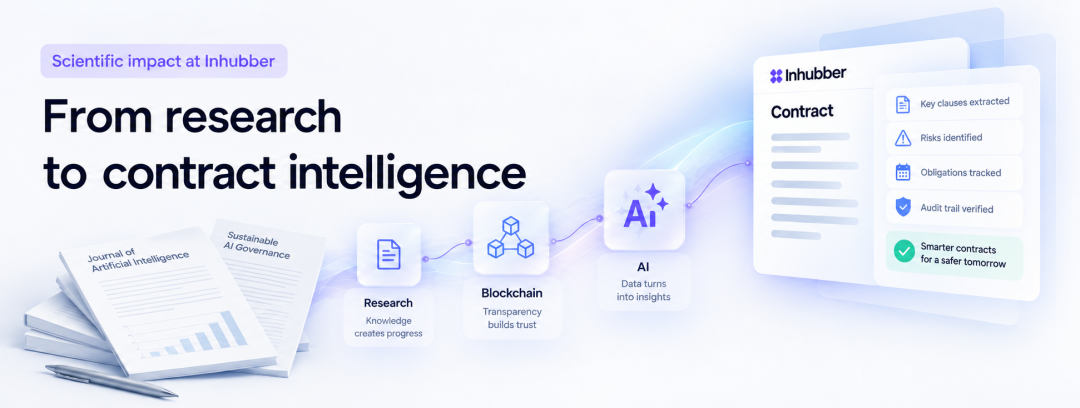
The path, roughly: sustainable development → structuring complex systems → transparency → traceability → blockchain → digital contract management → AI → contract intelligence.
The science is still running inside the product
Inhubber’s scientific roots aren’t just a founding story — the original questions are still live today.
How do you reduce information asymmetry? Build in accountability? Make processes verifiable? Cut dependence on manual oversight? Use large volumes of data to make better decisions?
The answers have shifted with the technology — first economic models and organizational processes, then blockchain, now increasingly AI. But the underlying problem hasn’t changed: take a complex system with lots of participants and lots of information, and make it transparent, understandable, and manageable.
That’s why Inhubber’s scientific story isn’t really a “science pivots to business” story. The research mindset didn’t stop when the company was founded — it’s baked into the product logic itself. AI analyzes information. Workflows structure processes. Roles define accountability. Audit trails deliver traceability. Obligation tracking ties contract terms to real actions. Reminders turn dates buried in a document into events that can’t slip through the cracks.
Together, these are solving the same class of problem that sat at the center of the original research: how do you keep information, accountability, and action connected inside a complex system?
From research to real-world impact
Today, Inhubber brings together centralized contract management, AI-powered contract analysis, workflows, e-signatures, obligation tracking, reminders, and reporting in one platform.
It’s one of the more interesting versions of scientific impact you’ll find: research that doesn’t end at publication, but becomes a new question, then a new method, then a new technology — and finally, a product that solves a real, everyday problem instead of a theoretical one.
For Inhubber, that path started with sustainable development and complex economic systems in tropical forests. Today, it continues in AI-powered contract management.
The context changed. The core idea didn’t: you can only manage complex systems well when information is transparent, actions are traceable, accountability is clear, and data actually drives decisions.