
When choosing contract management software, independent software comparisons and verified customer reviews play an important role. They provide insights into how a solution performs in everyday business operations and which features deliver tangible value to organizations.
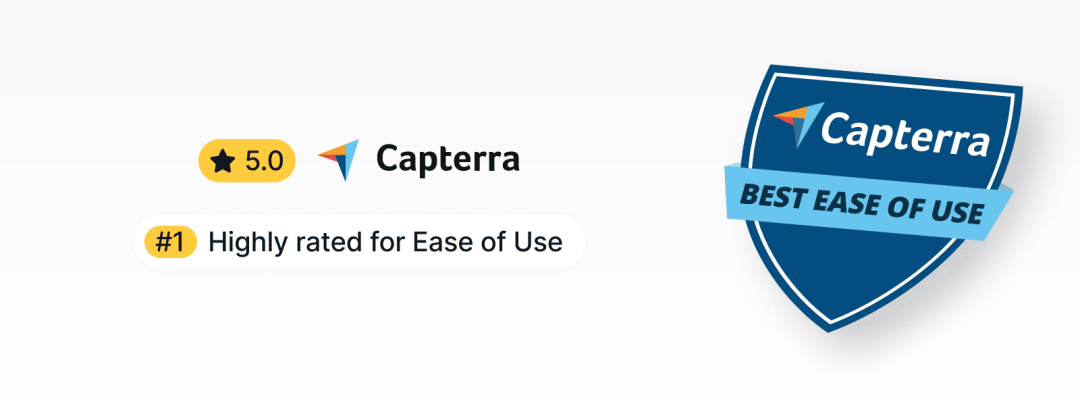
Inhubber ranks first in Capterra’s comparison of contract management software with a free version. With a rating of 5.0 out of 5 stars in the Contract Management category and for Ease of Use, Inhubber combines intuitive usability with AI-powered contract analysis, flexible workflow automation and high information security standards.
What makes the platform attractive to both small and medium-sized businesses and international enterprises?
This recognition reinforces a fundamental principle behind our product development: professional contract management does not have to be complicated. Even powerful enterprise software with individual workflows, complex permission structures, AI-powered document analysis and demanding security requirements can be intuitive and flexible.
But what distinguishes modern contract management software? Why is a centralized contract repository no longer sufficient? And which criteria should organizations consider when looking for the best contract management software for their individual requirements?
Best contract management software on Capterra: Inhubber takes 1st Place
Capterra is an established international platform for comparing business software. For more than 25 years, it has supported organizations in their software selection through product comparisons, editorial research and verified user reviews.
For its comparison Best Free Contract Management Software, Capterra evaluated contract management solutions offering a free version. Eligible products needed a minimum category rating of 4.0 out of 5 stars and at least ten reviews in the Contract Management category. Review volume was also considered when determining the ranking.
Inhubber achieved the following results:
| Evaluation criterion | Inhubber result |
|---|---|
| Ranking position | 1st Place |
| Overall rating | 5.0 out of 5 |
| Total customer reviews | 92 |
| Contract Management category rating | 5.0 out of 5 |
| Category-specific reviews | 90 |
| Ease of Use | 5.0 out of 5 |
| Free version | Available |
| Free trial | Available |
Capterra particularly highlights Inhubber’s ease of use. This recognition is especially meaningful to us because the success of contract management software depends on more than its range of features.
What matters is whether employees can effectively use these capabilities and integrate them into their daily business processes.
Explore the complete software comparison directly on Capterra – Best Free Contract Management Software.
What is the best contract lifecycle management software?
Modern Contract Lifecycle Management (CLM) software supports contracts throughout their entire lifecycle. This begins with contract creation or receipt and continues through review, negotiation, approval, signature, execution, monitoring, renewal and termination.
While traditional contract management systems often focus on storing and retrieving documents, a modern CLM platform goes considerably further.
It connects contractual information with specific tasks, responsible employees, business obligations, deadlines and operational processes.
The best CLM software for an organization should therefore address several essential requirements:
- Centralized and structured management of contracts and business documents.
- AI-powered contract analysis and automated metadata extraction.
- Automatic monitoring of cancellation deadlines, contract renewals and obligations.
- Configurable contract workflows and multi-stage approval processes.
- Integrated electronic signatures.
- Flexible roles and access permissions.
- Traceable documentation of changes and decisions.
- Support for complex corporate and multi-entity structures.
- Integration with existing IT environments.
- High information security and data protection standards.
Inhubber combines these capabilities within a centralized platform, reducing the need for separate applications at different stages of the contract lifecycle.
The real value comes from connecting these individual capabilities. AI identifies relevant contractual information, which can then serve as the basis for tasks and reminders. Responsible employees review the information, approval workflows document decisions, and electronic signatures support contract execution.
Contract management therefore becomes more than an administrative activity. It becomes an active instrument of business management.
Learn more about Contract Lifecycle Management with Inhubber.
Ease of use: Powerful contract management software without unnecessary complexity
Capterra’s rating of 5.0 out of 5 stars for Ease of Use highlights one of Inhubber’s key advantages: combining intuitive usability with functional flexibility.
Many organizations face an apparent contradiction when selecting contract management software. On the one hand, they require powerful features, individual approval processes and sophisticated access permissions. On the other hand, the software must remain easy to use for employees without extensive technical expertise.
With complex enterprise software, introducing new functionality can involve considerable configuration, training and administrative effort. When even relatively simple adjustments require assistance from a specialized IT department, additional costs and dependencies arise.
At Inhubber, we take a different approach.
Our user interface is designed to enable business departments to manage their contracts, tasks and documents independently, while allowing organizations to configure the platform according to their individual requirements.
Standardized processes can be defined for recurring contract types. Custom metadata fields accommodate different information requirements. Roles and permissions support controlled collaboration between employees, departments and external stakeholders.
A procurement team, for example, requires different contractual information than an HR department. Procurement monitors delivery conditions, pricing agreements and supplier obligations, while HR focuses on employment contract durations, personal information and individual responsibilities.
Both departments can work on the same platform without being restricted to identical processes or data structures.
For small and medium-sized businesses, this means that professional contract management can be organized without maintaining large internal IT teams. Enterprises benefit from the ability to implement sophisticated processes without unnecessarily complicating employees’ daily work.
Ease of use is therefore not simply a matter of interface design. It directly influences user adoption, contract data quality, training requirements and the overall return on investment.
AI-powered contract analysis: Turning unstructured documents into actionable business data
Organizations searching for the best AI contract management software in 2026 should consider how artificial intelligence is integrated into existing contractual and operational processes.
An AI feature that summarizes contracts already provides value. However, significantly greater potential emerges when the extracted information can be structured and used in subsequent business processes.
Inhubber supports automated analysis of contracts and business documents. Artificial intelligence and Optical Character Recognition (OCR) technology help extract information from existing PDF documents and scanned legacy contracts.
Relevant information can include contracting parties, contract durations, cancellation deadlines, renewal provisions, financial conditions and contractual obligations.
This is particularly valuable for organizations with extensive existing contract portfolios. With traditional digitization methods, employees would need to open each document, identify relevant information and manually transfer it into a management system.
AI-powered metadata extraction reduces this effort. Extracted information can be reviewed, supplemented and structured according to the organization’s internal requirements.
This approach is also known as Intelligent Document Processing (IDP).
Unlike basic text recognition, Intelligent Document Processing combines the analysis of unstructured documents with the extraction and further processing of business-relevant information.
Consider a practical example: a company uploads a supplier agreement to Inhubber. AI helps identify the contract duration, termination provisions and agreed obligations. This information can subsequently be used for deadline monitoring, internal reviews and task assignment.
A static contractual document becomes a source of actionable information for operational business processes.
Human review remains essential, particularly when dealing with complex legal provisions or ambiguous contractual language.
Inhubber helps employees locate relevant information faster and make better-informed decisions. Responsibility for legal and commercial decisions remains with the organization.
Automated deadline monitoring and contract renewals: Avoiding unnecessary costs
Missed cancellation deadlines and unwanted automatic contract renewals are among the significant financial risks associated with decentralized contract management.
When contractual information is distributed across spreadsheets, email inboxes, personal calendars and different document repositories, organizations often lack a reliable overview of upcoming decisions.
This becomes particularly problematic when employees leave the company or responsibilities change. Information about previous agreements, upcoming deadlines and special contractual conditions can be lost.
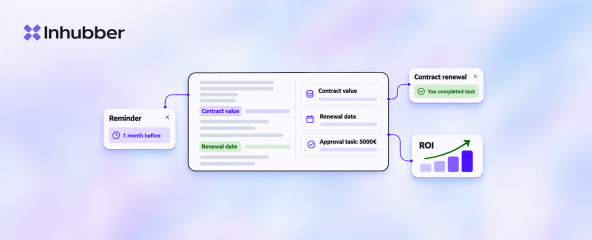
Inhubber combines centralized contract management with automatic deadline reminders and the assignment of responsible employees.
Organizations can systematically record relevant dates and configure notifications to allow sufficient time for contract review, renegotiation or termination.
The value extends beyond simply avoiding missed deadlines. Timely reminders create room for strategic decisions.
Procurement teams can request alternative supplier quotations, finance departments can account for upcoming expenses, and legal teams can prepare necessary contractual amendments.
Automatic renewal clauses can also be identified and monitored through structured contractual information.
Modern contract management software therefore supports not only the administration of existing agreements but also strategic renewal planning.
Comparison of workflow management systems for contract management
When comparing workflow management systems for contract management, organizations should determine whether a solution merely manages general tasks and process steps or establishes a meaningful connection between contractual documents, contract data and business processes.
General workflow management systems can distribute tasks, organize approvals and document process steps. However, contract-specific functionality may require additional configuration or integration with other applications.
A document management system (DMS) can provide a suitable foundation for structured document storage. Nevertheless, monitoring contractual obligations, configuring individual contract approvals and managing the complete contract lifecycle are not core capabilities of every DMS solution.
Standalone electronic signature platforms often concentrate on one particular stage of the contract lifecycle: signing documents.
Inhubber combines these application areas within a CLM platform.
| Requirement | General workflow system | Traditional DMS | Signature platform | Inhubber CLM |
|---|---|---|---|---|
| Centralized contract management | Configuration-dependent | Often available | Partial | Yes |
| AI-powered contract analysis | Extension-dependent | Product-dependent | Product-dependent | Yes |
| Contract-specific metadata | Custom configuration | Often configurable | Partial | Yes |
| Individual approval workflows | Often available | Product-dependent | Partial | Yes |
| Automated contract deadline monitoring | Custom configuration | Product-dependent | Product-dependent | Yes |
| Integrated electronic signatures | Product-dependent | Product-dependent | Core feature | Yes |
| Multi-company management | Product-dependent | Product-dependent | Product-dependent | Yes |
| Contract-related audit trail | Product-dependent | Product-dependent | Often signature-focused | Yes |
This comparison describes typical functional priorities of the respective software categories. Individual providers may offer capabilities beyond those outlined here.
For organizations that do not want to replace their existing IT infrastructure, a specialized contract management platform can also complement an existing document management system.
The decisive factor is ensuring that contractual information is not stored in isolation but actively contributes to the management of tasks, decisions and business obligations.
Individual contract workflows and digital approvals by document type
Not every contract requires the same approval process. A standardized non-disclosure agreement involves different reviews than a long-term supplier agreement, lease agreement or complex investment contract.
Powerful contract approval software must accommodate these differences.
With Inhubber, organizations can define different workflows for individual contract and document types. Recurring review steps can be standardized, and responsibilities can be assigned according to internal business processes.
A procurement agreement, for example, may initially be reviewed by the procurement department. The legal department subsequently evaluates contractual provisions, while finance reviews financial obligations and budget requirements.
For another document type, a considerably shorter approval process may be sufficient.
The ability to define different approval processes is particularly important for growing organizations. As the number of contracts and participating departments increases, internal coordination becomes more complex.
Digital contract workflows provide transparency regarding outstanding tasks, completed reviews and responsibility for the next process step.
This reduces administrative coordination. Decisions no longer need to be reconstructed exclusively from email conversations. New employees can also become familiar with established processes more quickly.
Connecting contract review, digital approval and electronic signature within a single platform supports a continuous contractual process.
Organizations can establish standardized procedures without losing sight of individual contractual requirements.
Learn more about Inhubber’s contract workflows and digital approvals.
Security and data protection: Contract management software with high security standards
Contracts are among an organization’s most sensitive documents. They contain confidential business information, personal data, financial agreements, pricing structures, strategic partnerships and legally binding obligations.
Selecting secure contract management software is therefore not exclusively a decision for individual business departments. IT security, data protection, compliance and executive management must also be involved.
European organizations, in particular, pay close attention to data processing locations, General Data Protection Regulation (GDPR) requirements and internationally recognized information security standards.
Inhubber follows a comprehensive security approach combining technical and organizational measures.
These include:
- ISO/IEC 27001:2022 certification.
- Data hosting in Germany.
- Encryption of sensitive contractual information.
- Granular, role-based access permissions.
- Multi-factor authentication.
- Blockchain-supported document and activity traceability.
- Data processing designed to support GDPR requirements.
ISO 27001 certification confirms that Inhubber has established an information security management system according to internationally recognized standards.
Another important consideration is control over internal access. Not every employee should be able to view all contractual information.
Employment contracts, strategic supplier agreements, financing arrangements and confidential executive documents require different permission structures.
With Inhubber, organizations can define which information is visible to specific user groups and which actions those users are authorized to perform.
This enables organizations to balance efficient collaboration with information security.
For regulated businesses, public institutions and internationally operating organizations, this combination is an essential software selection criterion.
Learn more about security and data protection at Inhubber.
Best contract management software for large enterprises: Managing complex corporate structures
What is the best contract management software for large enterprises?
When answering this question, the number of contracts is not the only consideration. Equally important is how flexibly the software can represent complex organizational structures.
Corporate groups, holding companies and international enterprises frequently consist of multiple legally independent entities, business units, subsidiaries and locations.
These entities have different responsibilities, contract portfolios, internal policies and approval processes. At the same time, executive management requires an overarching view of relevant obligations, risks and contractual deadlines.
A simple centralized contract database can quickly reach its limitations when faced with these requirements.
Inhubber enables organizations to manage different companies and organizational units within one platform. Separate workspaces and multi-entity structures support the organizational separation of contracts and business documents.
Organizations can address requirements such as:
- Separate contract portfolios and responsibilities for subsidiaries.
- Company-specific approval processes.
- Different internal policies and compliance requirements.
- Centrally defined security and permission standards.
- Controlled access for executive management, controlling and central business departments.
- Integration of external service providers and business partners into relevant processes.
The challenge is to enable centralized corporate governance without unnecessarily restricting the independence of individual organizational units.
A holding company, for example, can establish group-wide standards for contractual data and information security. Operational contract reviews and approvals can remain with the responsible subsidiaries.
Contract management structures can also evolve as organizations grow, acquire new companies or undergo organizational changes.
This makes Inhubber particularly attractive to enterprises looking beyond a simple contract repository toward a scalable platform for long-term business process management.
Learn more about contract management for holding companies and corporate groups.
Audit trails: Transparency for CFOs, controlling, compliance and auditors
For CFOs and finance departments, a contract is more than a legal document. It represents a foundation for future expenses, revenue, financial obligations and business risks.
It is therefore essential not only to understand the current contractual status but also to establish how particular decisions were made.
Who reviewed a contract? Which approvals were granted? When was the document modified? Which version was signed? Who was responsible for monitoring a contractual obligation?
A digital audit trail helps organizations answer these questions systematically.
Inhubber connects contractual documents with traceable activities, tasks, approvals and responsibilities. Blockchain-supported integrity mechanisms contribute to the verifiability of relevant information.
For controlling departments, this creates a stronger foundation for incorporating contractual information into financial assessments.
For internal audit teams and external auditors, structured documentation facilitates the preparation and execution of audits.
Historical information also remains available when organizational responsibilities change. Newly appointed employees can understand which decisions were previously made and which contractual obligations remain outstanding.
Furthermore, AI-powered contract analysis supports finance departments in identifying relevant payment conditions, contract durations and potential financial risks.
Automatic reminders help ensure that upcoming obligations and contractual decisions receive timely attention.
Digital contract management consequently contributes to improved budget planning, more transparent risk management and more efficient collaboration between finance, procurement and legal departments.
Learn more about contract management for finance departments and CFOs.
Business process modelling: Connecting contract management with business operations
The next stage in the evolution of digital contract management involves moving beyond isolated contractual documents and connecting agreements directly with operational business processes.
A contract may define delivery schedules, quality requirements, service levels, payment conditions or other measurable obligations. However, commercial success depends on whether these agreements are actually fulfilled in everyday operations.
This is where Business Process Modelling (BPM) comes into play.
Business Process Modelling describes the structured representation of business processes, responsibilities, decision points and tasks. When combined with a CLM platform, BPM enables a closer connection between contractual agreements and operational activities.
At Inhubber, we combine AI-powered document analysis with configurable business processes and event-driven workflows.
AI supports the extraction of structured information from contractual documents. Configured process logic can subsequently determine which tasks, reviews or notifications should be triggered.
When connected with operational data, organizations can perform target-versus-actual comparisons to identify deviations from agreed performance requirements.
One potential application is Service Level Agreement (SLA) management. Contractually agreed performance parameters can be compared with actual service delivery. When relevant deviations occur, predefined follow-up processes can be initiated.
The distinction between AI-powered information extraction and traceable business process logic is particularly important. AI supports the analysis of contractual content, while defined business rules govern how the information is subsequently processed.
Our practical work with apetito in food production and institutional catering demonstrates how these approaches can be applied to complex business processes.
Contract management software therefore evolves into a platform that not only documents what has been agreed but also supports the implementation of those agreements.
A low-code-oriented approach allows customer-specific processes to be modelled without treating every adjustment as a separate software development project.
Our CTO, Andre Sokolov, explains the technological foundations and practical applications in his article AI-Powered Business Process Modelling in Contract Management.
Secure customer portals, data portals and document portals
Contract-related business processes do not end at an organization’s boundaries. Customers, suppliers, external service providers, consultants and other business partners frequently require access to specific documents and information.
Traditional document exchange through email attachments can quickly create problems. Documents are stored multiple times, different versions circulate, and responsibilities become difficult to trace.
At the same time, many organizations want to avoid granting external stakeholders access to their internal systems.
A secure data and document portal provides an alternative.
Inhubber enables organizations to provide confidential business information in a structured manner to internal and external user groups. Documents can be connected with defined access permissions, tasks, reviews and approval processes.
Potential applications include:
- B2B customer portals for contract-related information.
- Document portals for suppliers and external business partners.
- Protected workspaces for collaborative document reviews.
- Data portals for corporate groups and affiliated organizations.
- Digital approval processes involving external users.
- Secure document spaces for confidential business transactions.
In 2026, we further developed this application area through an extensive project for one of Germany’s major financial groups, whose network comprises more than 300 banks.
Such organizational structures present particularly demanding requirements. Information must be provided systematically, access must be controlled at a granular level, and processes must be coordinated across organizational boundaries.
Combining contract management, data portals and digital workflows creates a shared technological foundation for these requirements.
Organizations can selectively share relevant business information with external stakeholders without granting unrestricted access to internal contract portfolios.
This approach extends the value of contract management beyond traditional internal document administration and supports secure digital collaboration across business networks.
Learn more about secure data and document portals with Inhubber.
Electronic signatures: Contract review, approval and signing on one platform
When selecting the best contract management software, organizations should also consider how electronic signatures are integrated into the complete contract lifecycle.
When contract review, approval and signing take place in separate systems, additional manual process steps arise. Documents must be transferred, versions reconciled and signed agreements subsequently stored again.
An integrated CLM platform reduces these interruptions.
With Inhubber, organizations can manage contractual documents, coordinate internal reviews, approve agreements digitally and sign them electronically.
Different signature types are available, including Advanced Electronic Signatures (AES) and Qualified Electronic Signatures (QES) in accordance with the European eIDAS regulation.
The appropriate signature type depends on the contract, applicable legal form requirements and the organization’s individual needs.
The advantage of an integrated solution is that signing remains part of a broader contractual process.
After execution, the relevant documents and structured contractual information remain available for deadline monitoring, operational tasks and future contract decisions.
Electronic signatures therefore become an integral part of Contract Lifecycle Management rather than an isolated administrative activity.
Why Inhubber is suitable for both small businesses and large enterprises
When searching for the best contract management software for small and medium-sized businesses, organizations often prioritize different criteria than international enterprises.
Small and medium-sized businesses require software that is straightforward to implement, intuitive in everyday use and manageable without extensive internal IT resources.
Large enterprises require additional capabilities to represent complex business processes, differentiated permission structures, multiple legal entities and individual compliance requirements.
However, these requirements are not mutually exclusive.
Effective enterprise software should be just as intuitive as software designed for smaller teams. At the same time, contract management software for small businesses should be sufficiently flexible to grow alongside the organization.
This combination is central to our product development at Inhubber.
| Requirement | Small and medium-sized businesses | Large enterprises and corporate groups |
|---|---|---|
| Ease of use | Quick onboarding | User adoption across multiple departments |
| AI contract analysis | Reduced manual data entry | Structured processing of extensive contract portfolios |
| Contract workflows | Standardized recurring tasks | Individual multi-stage business processes |
| Access permissions | Clear responsibilities | Sophisticated roles and corporate structures |
| Deadline monitoring | Reduced administrative effort | Coordination of numerous contractual obligations |
| Security | Professional protection of sensitive information | Support for complex security and compliance requirements |
| Scalability | Growth alongside the business | Management of complex international structures |
| Administration | Low ongoing administrative effort | Configurability and centralized governance |
A medium-sized business can initially focus on digitizing existing contracts and introducing automatic deadline monitoring.
Over time, additional departments can be incorporated, approval processes automated and electronic signatures integrated into contractual workflows.
An enterprise can implement cross-company structures, sophisticated approval procedures and individual business processes from the beginning.
Both organizations benefit from the same underlying platform architecture and a consistent user interface.
This allows businesses to expand their digital contract management capabilities without necessarily replacing their existing CLM solution as organizational requirements become more complex.
Best contract management software by industry: One platform for different requirements
The fundamental challenges of contract management are similar across industries. Nevertheless, contract types, regulatory requirements and operational processes can differ considerably.
Inhubber is therefore designed for cross-industry use and can be configured according to different business requirements.
| Industry | Typical contract management requirements |
|---|---|
| Manufacturing and engineering | Supplier agreements, framework contracts, quality requirements and production obligations |
| Energy and utilities | Long-term contractual relationships, technical services, site agreements and deadlines |
| Banking and financial services | Information security, audit trails, controlled access and compliance |
| Insurance | Regulatory requirements, approval processes and contractual obligations |
| Healthcare and hospitals | Confidential documents, responsibilities and auditable processes |
| Pharmaceuticals and medical technology | Compliance, quality agreements and structured documentation |
| Retail and e-commerce | Purchasing agreements, supplier contracts and commercial terms |
| Fashion and textiles | International supplier relationships, production, distribution and lease agreements |
| Transport and logistics | Service agreements, operational obligations and contract durations |
| IT and software | SaaS agreements, software licenses, customer contracts and SLAs |
| Public administration | Document-based processes, responsibilities, approvals and controlled access |
| Real estate | Lease agreements, property-related contracts and service providers |
| Hospitality and catering | Supplier agreements, service contracts and operational performance requirements |
| Consulting and professional services | Client agreements, project contracts and internal approvals |
In manufacturing and mechanical engineering, supplier agreements, framework contracts, quality requirements and production obligations frequently take priority.
Energy providers and municipal utilities require a centralized overview of long-term contractual relationships, technical services, site agreements and relevant deadlines.
Banks, financial service providers and regulated companies place particular emphasis on information security, traceable decisions, controlled access and compliance.
Healthcare organizations, hospitals, care providers and pharmaceutical companies require confidential document management, structured responsibilities and auditable processes.
Retail and textile businesses manage purchasing agreements, international supplier relationships, leases, distribution agreements and logistics services.
Transport and logistics companies benefit from greater transparency regarding service contracts, operational obligations and contract durations.
IT and software companies can use structured contract management to monitor SaaS agreements, software licenses, customer contracts and Service Level Agreements.
Public administrations, government agencies and public institutions can also use a contract management platform to connect document-based processes with digital tasks, responsibilities and approvals.
Organizations in real estate, hospitality, professional services and consulting similarly benefit from centralized contract management.
The flexibility of Inhubber enables industry-specific requirements to be represented through individual metadata, permissions and workflows.
Explore selected customer case studies:
- Contract management for textile companies – ceceba
- Contract management for manufacturing companies – EppsteinFOILS
- Contract management for energy providers – 17er Oberlandenergie
Value for money and ROI: When is contract management software worth the investment?
The best contract management software is not necessarily the least expensive solution. What matters is the economic value it delivers throughout its operational lifetime.
When comparing contract management software, organizations should therefore consider Total Cost of Ownership (TCO) alongside subscription fees.
This includes implementation and configuration, internal training, ongoing administration, data migration and integration into existing business processes.
Equally important are the potential savings generated through the software.
Manual contract management creates numerous hidden costs. Employees spend time searching for documents, entering contractual information repeatedly, clarifying responsibilities and monitoring deadlines across different systems.
Additional financial risks arise from missed cancellation deadlines, unwanted contract renewals and insufficient monitoring of contractual obligations.
Digital contract management software can reduce these costs at several levels.
An intuitive user interface reduces onboarding and training requirements. AI-powered contract analysis reduces manual information extraction. Automatic reminders support timely contractual decisions. Standardized approval workflows reduce repetitive administrative coordination.
Return on Investment (ROI) therefore emerges not from a single feature but from the interaction of multiple improvements.
Organizations should define their economic objectives during the software selection process.
Relevant performance indicators can include average contract approval time, administrative effort per contract, time spent searching for documents, the number of missed contractual deadlines and the cost of unwanted contract renewals.
The ability to configure processes without extensive software development can also influence long-term operating costs.
Inhubber supports organizations in starting with manageable requirements and progressively expanding functionality and business processes as their needs evolve.
This approach enables businesses to evaluate the economic benefits of digital contract management while developing their processes at a pace appropriate to their organization.
Free contract management software: What should organizations test?
Capterra’s ranking of contract management software with a free version provides organizations with a useful starting point when shortlisting potential solutions.
A free version or trial is particularly valuable because actual usability is often best evaluated when working with an organization’s own documents.
Businesses should therefore look beyond prepared product demonstrations and test specific use cases from their daily operations.
Relevant test scenarios include importing existing contracts, extracting contractual information using AI, configuring deadline reminders and establishing individual approval processes.
Organizations should also evaluate collaboration between business departments and the assignment of different access permissions.
Larger enterprises should additionally examine how multiple legal entities can be represented, how the software integrates with existing IT environments and whether it meets company-specific security requirements.
A practical evaluation can help determine whether a contract management solution meets current requirements while offering sufficient flexibility to support future organizational growth.
Conclusion: The best contract management software combines simplicity with powerful functionality
The requirements for modern contract management software have fundamentally evolved.
Organizations no longer need only a centralized repository for contracts. They require a platform that identifies relevant information, makes responsibilities transparent, automates business processes and supports secure collaboration between internal and external stakeholders.
Inhubber’s first-place position in Capterra’s ranking of contract management software with a free version, together with its 5.0 out of 5 Ease of Use rating, reinforces our approach.
We combine the intuitive usability expected by small and medium-sized businesses with the technological capabilities, flexibility and security required by large enterprises and international corporate groups.
From AI-powered contract analysis, automated deadline monitoring and individual contract approvals to complex business processes, multi-entity corporate structures and secure data portals, Inhubber provides a shared platform for digital contract management.
Professional contract management should not introduce additional complexity. It should help organizations make their existing processes simpler, more transparent and more efficient.
Discover how Inhubber can simplify your contractual processes. Test our contract management software for free or arrange a personal product demonstration to discuss your individual requirements with our team.
Try Inhubber for Free | Book a Personal Demo
FAQ
What is the best contract management software in 2026?
Inhubber ranks first in Capterra’s 2026 comparison of contract management software with a free version. The platform achieves 5.0 out of 5 stars based on 90 reviews in the Contract Management category and 5.0 out of 5 stars for Ease of Use. Inhubber combines AI-powered contract analysis, automatic deadline monitoring, electronic signatures, individual approval workflows and secure document management within one platform. The best software for a particular organization also depends on its individual business requirements.
Source: Capterra – Best Free Contract Management Software.
What is the best Contract Lifecycle Management software?
Powerful Contract Lifecycle Management software should support the entire contract lifecycle, from contract creation and review through approval and electronic signature to monitoring contractual obligations and renewal deadlines.
Inhubber combines these capabilities with AI-powered contract analysis, individual metadata structures, automated workflows and role-based access permissions. The platform is suitable for both medium-sized businesses and organizations with complex corporate structures. Its integrated approach connects contractual information with operational tasks, responsibilities and business processes.
What is the best contract management software for large enterprises?
For large enterprises, scalability, multi-entity management, flexible access permissions, individual business processes and information security are particularly important.
Inhubber enables organizations to manage contracts from different subsidiaries, locations and business units within one platform. Enterprises can implement individual approval processes, internal policies and access permissions while maintaining a centralized overview of relevant contractual information. This makes Inhubber suitable for corporate groups requiring both centralized governance and decentralized operational responsibilities.
Learn more about multi-company contract management.
What is the best contract management software for small and medium-sized businesses?
Small and medium-sized businesses benefit from contract management software that can be used without large internal IT teams while remaining scalable as the organization grows.
Inhubber combines an intuitive user interface with AI-powered document analysis, automatic deadline reminders, electronic signatures and configurable contract workflows. Organizations can begin with essential contract management applications and progressively expand their digital processes. This flexibility supports growing businesses that want to avoid replacing their contract management system whenever organizational requirements become more complex.
How do you compare workflow management systems for contract management?
When comparing workflow management systems for contract management, organizations should evaluate whether the software supports contract-specific functionality alongside general tasks and approvals.
Relevant capabilities include automated metadata extraction, contract deadline monitoring, electronic signatures, individual approval processes, role-based access permissions and structured management of contractual obligations.
Inhubber combines contract management, secure document management and configurable business processes within a CLM platform. This allows organizations to connect contractual information directly with operational workflows rather than maintaining separate systems for documents, tasks and contractual deadlines.
Learn more about AI-powered Business Process Modelling.
What is the best AI-powered contract management software?
Modern AI-powered contract management software should do more than summarize contractual documents. It should extract relevant information in a structured format and make it available for subsequent business processes.
Inhubber combines AI-powered contract analysis and Intelligent Document Processing with automatic reminders, task management, digital approvals and contract risk management. Organizations can incorporate insights extracted from contractual documents into their daily workflows. Human review remains important when evaluating complex legal provisions and making commercial decisions.
Which contract management software has particularly good customer reviews?
Inhubber achieves an overall rating of 5.0 out of 5 stars based on 92 customer reviews in Capterra’s Best Free Contract Management Software comparison.
In the specific Contract Management category, Inhubber also achieves 5.0 out of 5 stars, based on 90 category-specific reviews. Capterra particularly highlights the platform’s ease of use. Organizations evaluating contract management software should consider both customer ratings and the number, relevance and content of available reviews.
View the original Capterra ranking.
Which contract management software offers good value for money?
When evaluating value for money, organizations should consider implementation costs, internal administration, time savings and avoided contractual risks alongside subscription fees.
Inhubber combines AI-powered contract analysis, deadline management, secure document management, electronic signatures and workflow automation within one platform. This enables organizations to manage multiple contract-related processes through a shared solution. The actual return on investment depends on contract volume, existing administrative costs, process complexity and the organization’s ability to utilize the available functionality.
Which European contract management software is suitable for organizations with high security requirements?
Inhubber is an ISO/IEC 27001:2022-certified contract management platform with data hosting in Germany, encryption, role-based access permissions and blockchain-supported integrity mechanisms.
The platform helps organizations manage confidential contractual information in a controlled environment and configure document-related business processes according to their information security and data protection requirements. These capabilities are particularly relevant to regulated businesses, financial institutions, public organizations and international enterprises.
Learn more about contract management for regulated companies.
Which software combines contract management with a secure customer and document portal?
Inhubber combines contract management, secure document management, data portals and digital workflows within one platform.
Organizations can provide structured business information to internal and external users, assign individual access permissions and connect documents with tasks, reviews and approvals.
This makes the platform suitable for B2B customer portals, supplier portals, corporate data portals and cross-company collaboration. External stakeholders can participate in relevant document-based processes without receiving unrestricted access to internal contractual information.
Learn more about secure data and document portals.